Showing posts with label Forecast. Show all posts

Friday, January 3, 2014

Global Technology Market 2014 – IT spending worldwide expected to be better

Forrester Research predicts global technology market will grow by 6.2% to $2.22 trillion in 2014, fueled by an improving economy and growing interest in areas such as mobility and cloud computing and the market is dominated by United States followed by Europe that is slowly recovering from recession and even BRIC countries (Brazil, Russia, India and China) too are recovering from sluggish economic growth and Latin America and Eastern Europe, the Middle East, and Africa are expected to do well. The report forecasts technology spending is expected to grow in Brazil (11.6%), Mexico (10.1%), at 11.6% and 10.1%, China and India are also expected to grow 7.7 % each.

According to Forrester analysts growth will pick up pace in 2015 and forecasted to grow by 8.1%. “Tech Twelve country (Canada, the US, Denmark, Finland, the Netherlands, Sweden, Switzerland, the UK, Israel, Australia, Singapore, and New Zealand) CIOs can be more aggressive in their budget plans. Businesses and governments in these countries are eager to embrace new technologies and feel competitive pressure to do so given the pace of adoption by competitors in their own and similar countries,” the report said.

Software will account for the largest share of tech spending in 2014, at $568 billion, followed by IT outsourcing at $442 billion, IT consulting and integration services at $421 billion, computer equipment with $416 billion and communications equipment at $373 billion, according to Forrester's report. CIOs will focus their biggest spending increases on software, where growth globally will be 7.1% (in local currency terms) in 2014 and 10.2% in 2015. Analytics, applications and software-as-a-service (SaaS) applications are expected to see the fastest growth of any IT spending category. IT consulting and implementation services will also raise in line with higher software spending, according to Forrester Research.


Forrester Analysts led by Andrew Bartels expect hardware sales to trail behind software but the tablet market is expected to perform well dragged by slow and modest growth in laptops and PCs. The report also notes that spending on technology such as software as a service, mobile devices and tablets, platform-as-a-service (PaaS); smart computing and big data, real-time predictive analytics and big data tools will grow in 2014. IT outsourcing will be one of the weaker segments in 2014 and it will pick up in 2015, according to the report. Global technology market had seen a tough demand conditions in the past two years and the growth rates had been low which is expected to slightly pick up in 2014 and analysts predict a good growth in 2015. Economic and political instability in many countries across the globe are also a major concern for the technology market growth. Indian market will also see sluggish growth as there is General elections this year and political instability is major concern for the economy. 

Sunday, August 12, 2012

Global IaaS Industry 2011& Forecast 2014-2016 – Slow adoption by large Enterprises


Infrastructure as a Service is a cloud computing model in which the service provider owns the equipment (Hardware like Storage, Servers, Networking Equipment, etc.  & Software) and is responsible for housing, running and maintaining it and the client typically pays on a per-use basis.  Major players in the IaaS market include Leaders like Amazon Wen Services, Savvis, CSC, Terremark, Bluelock; Challengers like Navisite, Opsource, IBM, GoGrid; Visionaries like Rackspace, Joyent and Niche players like Hosting.com, Tier3, AT&T, Tata Communications, SoftLayer, iland, Carpathia Hosting, Datapipe and Virtacore Systems, according to Gartner Magic Quadrant December 2011. Gartner predicts IaaS is a fast growing market as players like Google & Microsoft entered this market and in future this market will be 1/3rd of the hosting market. Gartner also forecasts the IaaS market will generate $24.4B in revenue in 2016 from $5.6B in revenue in 2011 and IaaS is expected to grow by over $20B with a CAGR of 41.7% in the forecast period globally. The Compute sub segment is expected to see the greatest revenue growth globally, growing from $3.3B in 2011 to $20.2B in 2016, generating a 43.2% CAGR and other two sub segments CAGR growth - Storage (36.6%) and Print (16%).

Forrester predicts that IaaS market will initially grow for next few years but the market is expected to decline in the long term. Forrester’s report, “Sizing the Cloud”, highlights that IaaS is the second largest public cloud category with a $2.9 billion market size and “IaaS will reach a peak of $5.9 billion in global revenues in 2014 and will then enter a period of significant commoditization, price deterioration and margin pressure and between 2014 and 2020, as a result, the IaaS market will first stagnate and then decline, with total market revenues of $4.8 billion in 2020,” according to Forrester analysts Stefan Ried and Holger Kisker. Yankee Group analysts suggest IaaS might represent $2 billion to $3 billion, globally. IDC also estimates IaaS will decline to $15 billion in 2014 and most of the analysts believe the IaaS market will be larger than the PaaS market and IaaS is one of the most talked about in the cloud space, which saw several important improvements, such as changes in pricing strategies, the appearance of new smaller players, and the entrance of some technology heavyweights.

Enterprise Strategy Group survey published in January 2012 highlights that of more than 600 enterprise and mid-market companies globally; only 27% said they were using public cloud IaaS services. That's up 10% from a similar survey published in early 2011. But 28% of respondents said they have no immediate plans to jump into the cloud, and another 24% said they haven't pulled the trigger on a cloud deployment yet, but plan to at some point in 2012. SMBs are at the forefront of IaaS adoption totally for IT infrastructure needs but large enterprises are selective in adoption and using public IaaS primarily for these specific use cases: R&D projects, load testing, move non critical legacy applications from expensive on premise to off premise, build & deploy new apps and as part of SaaS or PaaS usage. With some of the large enterprises that selectively adopted IaaS couple of years back and who effectively utilized it are becoming test cases for more large enterprises to adopt IaaS within their organizations. There are also concerns that the pricing has not fallen for some time till now but with the entry of more players particularly Large IT players, businesses can expect more choice of offerings and reduction in prices.

Thursday, May 3, 2012

Global Semiconductor Industry will continue its slow growth in 2012


Global Semiconductor Industry saw tremendous growth in 2010 post the global financial crisis as major semiconductor companies invested in manufacturing facilities to meet the raising demand from consumers fueled by sales of tablets, personal computers, datacenter server demand and mobile phones particularly smart phones. But the growth stalled in 2011 due to the volatile macro economic environment particularly the European Debt Crisis and the US economic slowdown, subsequent effect on other countries particularly nations like India, China, etc that saw slowdown in economic growth, natural disasters like the Japan Earthquake and Tsunami, Thailand Flooding too played their part but the global semiconductor industry survived these adverse conditions and grew modestly in single digit. The industry went through bad patch in 2009 due to the Global financial crisis where the YoY growth declined by 20% but it recovered in 2010 with a remarkable double digit more than 20-30% growth but due to the above mentioned adverse conditions growth was modest between 2-4% in 2011. But with the growing consumer demand for tablets, e-readers, personal computers like laptops, ultra books, smartphones, datacenters and cloud computing, etc the Global Semiconductor Industry is expected to reach approximately $412.8 billion in 2016 according to IHS iSuppli Global Manufacturing Market Tracker report. Global semiconductor revenue will reach $324.6 billion with 4.37% YoY growth in 2012 where as industry grew by only 1% in 2011 according to IHS.

Source: IHS iSuppli Research, April 2012

According to IDC, Worldwide semiconductor revenues increased more than 3.7% YoY to $301 billion in 2011, compared to more than 24% YoY growth to $282 billion in 2010. IDC expects 2012 semiconductor revenue growth to be in the 6-7% range fueled by accelerated growth in second half of 2012 when fab utilization rates rise and semiconductor cycle that started in mid 2011 will bottom out by second half. Gartner forecasts worldwide semiconductor revenue to total $316 billion in 2012, a 4% increase from 2011 level of $306.8 billion, up $5.4 billion, or 1.8% from 2010 level of $301.4 billion. Gartner is expecting a rebound starting in the second quarter of 2012, supported by inventory corrections, bottoming foundry utilization rates and global economy stabilizing. According to both IDC and Gartner, Intel is the market leader with close to $51 billion in revenues; Samsung is number 2 with $27 billion revenues (Gartner) and $29 billion revenues (IDC).According IDC Texas Instruments is third followed by Toshiba and Renesas Electronics but according to Gartner Toshiba is number three followed by Texas Instruments and Renesas. Also similar difference is there for number seven and eight positions according to IDC Hynix is seven and STMicro eight but Gartner classifies STMicro is seven and Hynix is eight.

Microprocessors performed well in 2011 after not doing so well in 2010 and are expected to continue to do well in 2012 with high average selling price and strong demand for Intel chips for use in Personal computers like notebooks & ultra books and servers. NAND flash memory revenues are expected to grow in 2012 just the way they grew in 2011 fueled by strong increase in mobile consumer devices and solid-state drives. DRAM pricing fell by 50% has affected the overall industry revenues in 2011due to falling ASPs and oversupply as it poorly performed where in the revenues fell by 25%. But DRAM will see slight recovery in 2012 as one of the major player Elpida filed for bankruptcy. Inventory is a major concern for the industry and according to IHS despite the semiconductor suppliers reducing their inventory by 7.5% over the last 6 months, total inventory remains at high levels both in terms of aggregate dollar value as well as in days of inventory but further reductions at least another 5%, expected through H1 2012, are necessary for chip makers to experience sustained demand and growth.

Gartner forecasts semiconductor revenue from media tablets will reach $9.5 billion as unit production is expected to increase by 78% YoY, semiconductor revenue from PCs will reach $57.8 billion as unit production expected to increase 4.7% and semiconductor revenue for mobile phones will reach $57.2 billion as production is expected to grow 6.7% in 2012. Consumer demand from Asia Pacific and Americas is expected to rise further but demand in Japan and Europe is expected to be seeing negative growth. The semiconductor industry is also seeing consolidation as larger players have significant cash reserves and looking to acquire smaller players as companies in the industry is positioning themselves for the next phase of growth with devices becoming more intelligent and needing support for high-level operating systems, connectivity, and application processing capabilities, according to IDC. A number of mergers and acquisitions came to fruition in 2011, most notably Qualcomm–Atheros, Texas Instruments–National Semiconductor, SMSC–Conexant, Broadcom–NetLogic, CSR–Zoran, and Microsemi–Zarlink and this trend is expected to continue in 2012 according to IDC. Ultimately the growth of the global semiconductor industry is dependent on macroeconomic environment stabilizing and improving with containment of European Debt crisis and growth returning back to emerging countries like India, China, etc that drive demand for PCs, tablets like iPads and e-readers, Smartphones like iPhones, no major natural disasters, and manufacturers of PCs like notebooks, ultra books, servers, mobile phones, etc launch new models and attract more consumers. Most of the research firms and semiconductor companies expect that growth will return by second half of 2012.


Monday, April 30, 2012

Worldwide Social Network Users by Geographical Region – 2014 Forecast


Social Networking has seen rapid growth in the past couple of years with 1.2 billion social network users worldwide in 2011 and the users are forecasted to reach, 1.43 billion (2012), 1.66 billion (2013) and 1.85 billion (2014) according to eMarketer. Consumer Social Networking sites like Facebook, Twitter, Google+, LinkedIn, etc mostly used by consumers as well as businesses have been seeing tremendous growth as evident in the number of users like Facebook (850 million), Twitter (465million), LinkedIn (150 million) in 2012. These social networking sites had significantly influenced the lives of millions of users, how they communicate with friends and family, voice their opinions, collaborate and share knowledge, content and social networking sites too provided the tools and platforms that are easy to use, provided an unique experience, games and applications and kept users hooked to the sites as evident in the comScore report that online users spend 1 minute in ever 5 minutes on social networking sites. According to Radicati Group report, the total number of worldwide Social Networking accounts, including both Consumer and Enterprise accounts, expected to grow from about 2.4 billion in 2011, to about 3.9 billion in 2015. The number of Social Networking users is expected to rise from 798 million users in 2011, to over 1.2 billion in 2015. (Note: users typically have more than 1 account).

Source: eMarketer "Worldwide Social Network Usage: Market Size and Growth Forecast" report.

Asia Pacific is the dominant region due to the number of countries and online population is higher. China dominates the region with close to half of the users of the total Asia Pacific social network users are from China. Other countries from Asia Pacific that figure in the top ten social network users list are India, Indonesia, Japan, South Korea and Australia. Latin America is the second dominant region with Brazil dominating followed by Mexico and Argentina. North America is dominated by US and Canada. Eastern Europe is dominated by Russia. Western Europe is dominated by Germany, UK, France, Italy and Spain. Worldwide social network users YoY growth is expected to slow down from 2012 as the market reaches maturity where in the YoY growth for 2012 will come down to 19% from 23% in 2011 and is forecasted to grow by 16% in 2013 and by 11.6% in 2014. Social Networking sites like Facebook, Twitter, Google+, etc will drive the growth along with localized social networking sites in regions like Asia will also contribute to growth. Mobile devices will drive more social network users in the emerging markets as most of mobile handset makers are equipping the mobile handsets with social networking for the customer use.


Monday, March 5, 2012

Global E-Reader Market Forecast – Decline in Growth from 2015


According to an IHS iSuppli Small & Medium Displays Market Tracker report, Shipments of monochrome e-book displays hit 27.1 million in 2011(108% YoY) from 13 million in 2010. Smaller, less expensive models with features like light weight and good battery life are driving sales. Most of the players in this segment whose models are monochrome had started adopting the color displays with touch screens in 2011 and consumer focused marketing strategy and availability of more digital content like fiction, non fiction and textbooks at affordable prices will drive growth in near future. IHS believes the players in the market have to look for new ways to attract new customers and there are growth opportunities in select vertical markets like education where the purpose of the devices will be more for reading than for other functionalities like browsing and communication.  The market will see significant growth till 2014 and will see growth decline from 2015 with tough competition from tablets. These devices are facing tough competition from tablets like Apple iPad that has significant functionality like faster browser, powerful chips for multi-media, good navigation, huge number of applications, etc. Dominant players in the market are Amazon Kindle, Barnes & Noble Nook, Sony Reader, Kyobo Reader, etc.

WitsView, a research division of TrendForce forecasted color E-Readers shipments to reach 12.3 million units in 2012 from 7.4 million units in 2011. Amazon with its low-priced Kindle Fire has strongly penetrated the market which has more than 60% market share in color E-Readers market and its pricing has become a benchmark for the tablet PCs. According to Gartner, E-reader sales are expected to reach 24.3 million units in 2011, and the market is expected to peak in 2013 with sales of 28 million units and the market will start to decline from then onwards due to competition from highly functional media tablets. IDC predicted e-Reader shipments of 27 million units in 2011 a massive rise in unit shipments when compared to 12.8 million units in 2010. Analyst firm Juniper Research forecasts that eReader shipments will reach 67 million by 2016 nearly triple the 25 million devices the company expects to reach the market in 2011. According to a Report by Global Industry Analysts, Inc, World e-readers market is forecast to reach 53.87 million units by the year 2017. Renub Research expects worldwide E-Reader unit sales will cross 50 Million and its market size will be over US$ 6 Billion by the end of 2014. According to the latest industry analysis from the Pew Internet & American Life Project, the share of adults in the United States who own tablet computers and e-readers nearly doubled from 10% to 19% between mid-December and early January.

Monday, February 13, 2012

Global Data Center Market - 2011 & Future Outlook


According to Gartner, Worldwide spending on servers, storage and enterprise data center networking equipment is expected to return to pre-recession levels and grow significantly in the coming years and reach to nearly $99 billion by 2011 and past $126 billion in 2015. In 2010, 2 percent of data centers contained approximately half of all data center floor space. In 2015, that same 2 percent of data centers will account for more than 70 percent of data center spending and contain 60 percent of total floor space.

After a three-year hiatus, the data center construction is coming back to its pre-recession levels, with construction worldwide expected to reach $45bn in 2011, by some estimates. Industry veteran Christian Belady of Microsoft has done an analysis, and projects that annual global spending on data center construction will increase from about $50 billion today to about $78 billion by 2020. The U.S. market for data center construction, currently about $15 billion a year, will likely grow to about $18 billion.


TechNavio's analysts forecast that the Global Data Center Outsourcing market will reach $163 billion in 2014. One of the key factors contributing to this market growth is decreasing data center outsourcing cost. The Data Center Outsourcing market has also been witnessing integration of cloud computing facilities. According to a new report from Pike Research, the investment in greener data centers will experience rapid growth over the next five years, increasing from $7.5 billion in global revenue to $41.4 billion by 2015, representing 28% of the total data center market.

According to Datacenter Dynamics, Industry Census 2011, the US rules, with $9.3bn in data center construction investment, followed by the UK, with $3.35bn, China ranked third, with $3.1bn in spending expected in 2012, followed by Germany, with $2.6bn, Australia with $2.45bn, and Brazil with $2.15bn. France, Italy, and Canada are close behind.


Most of the telecom companies, IT players like IBM, Dell, HP etc, Internet companies like yahoo, Google, Amazon etc, pure players like Equinox, DRT, Savvis etc all have data centers across the globe. Apart from these companies all governments both national as well as regional are also setting up their own data centers to store citizen data and provide better services to their citizens. Data centers building and Data Centers Outsourcing are driving growth in Global IT spending. The rise of internet and data is also driving significant growth in data center market.

Numbers highlight growth of the Data Center Market in the near future. With explosion of data and its storage, growing number of internet users and more businesses moving to the cloud computing the demand form more data centers and technologies will increase. The data center market provides good job opportunities and with development of new technologies and their adoption more jobs will be created. Data centers provide opportunities in System Administration, Networking, Hardware Equipment Maintenance, Software Application Development, Security Software Specialists, Electrical Engineers, Mechanical Engineers, Cooling Specialists, Fire Specialists and Security Services. 

Tuesday, December 6, 2011

Global IT Spending 2012 – Key Trends


IDC predicts that worldwide IT spending will grow 6.9% YoY to $1.8 trillion in 2012 and  20% of this total spending will be driven by smartphones, media tablets, mobile networks, social networking and Big Data analytics. Forrester research says IT purchases will be $2.042 billion in 2011 and $2.154 billion in 2012, with the growth driven mostly by underlying economic growth and adoption of newer technology. Gartner forecasts IT spending will be $3.7 trillion (7.6% YoY) in 2011 and expects the IT spending to reach $3.9 trillion (4.6% YoY) in 2012. Gartner IT spending includes Telecom spend and without telecom spend, total IT spend is $1.53 trillion (8.4% YoY) in 2011 and $1.62 trillion (6% YoY) in 2012.

IT spending and budgets did not see any cuts in 2011 but there will be cuts in spending in 2012. There will not be any drastic cuts as IT spending is critical for ongoing business success, but spend scrutiny and conservative plans are expected. The worst case scenario of the total unraveling of the Euro crisis is that the IT spending will increase by 1-2% YoY. This growth will be driven by the emerging economies like India, China, etc. Due to the Euro zone crisis and US Economic slow down IT spending is expected to grow by 4- 6% YoY way below the current levels of 7-10% YoY. Europe will be most affected market compared to US market.

Hardware, Software, IT Services will see single digit growth in 2012. Spends on these categories will be slow as companies will try to cut down spend and will not go for up gradations aggressively. Only business critical spend will be made. Mobile devices such as notebooks, tablets, and smartphones will overtake the PCs. Mobile applications and operating systems revenues will grow and will even surpass the mainframes revenues and the competition is expected to intensify with major vendors like Microsoft, Amazon, Apple and Google coming into market with new offerings.

Cloud Computing will become more competitive as all the major vendors like Amazon, IBM, Microsoft, Google, etc are focusing on creating application platforms and ecosystems. Not only these major vendors but also Indian Outsourcing vendors are developing the cloud based offerings and platforms and are aggressively marketing these to the clients. According to IBM, the demand for cloud computing is on the rise as organizations look to expand the impact of IT to deliver innovative services while realizing significant economies of scale. IDC analysts expect that cloud spending will be $36 billion next year. M&A is also expected in cloud space where the major vendors look to buy smaller and medium players looking to add more applications and content.

Social media is on the rise and it is expected to be critical for the consumers as well as businesses. Businesses are looking for social media tools that help them reach their customers, track their reputation and feedback of the customer and use it internally in the organization to interact with employees. Social media analytics is expected to be a big business as the businesses look for tools and gain critical insights from these tools to determine the effectiveness of their marketing programs, call center performance and cross-selling initiatives. There have been acquisitions in this segment where larger vendors are buying out smaller niche players with good product and platform and integrate it in their core offerings.

According to IDC, Big Data is critical in 2012 as the volume of digital content grows to 2.7 zettabytes (ZB), up 48% from 2011. More than 90% of this information will be unstructured (such as images, videos, MP3 files and files based on social media and Web-enabled workloads) -- full of rich information, but challenging to understand and analyze. 2012 is likely to be a busy year for Big Data-driven mergers and acquisitions as large IT vendors seek to acquire additional functionality. Business Intelligence and analytics key to unlock the data and use the data in organizational decision making and strategy formulations. Analyzing in real time is the future of analytics.

IT and BPO will also see growth in 2012. Clients will look for offerings from vendors that will have significant impact on their businesses. Vendors are adopting cloud computing and also offering end to end platform offerings and are increasingly looking for outcome based offerings that will increase their margins. Indian Outsourcing vendors are forecasting and preparing for the volatile economic situation and are actively interacting with clients on regular basis. As of now vendors are positive but they are expecting definite headwinds in 2012 and are confident to tackle such scenario.

App stores with lot of new applications, intelligent devices with sensors, tablets, and smart phones are being launched and these devices and apps are creating new businesses and are adding more functionality and are being actively integrated by the large vendors in their core product offerings. 2012 will see many new offerings in terms of hardware, software and services and despite the tough and volatile economic environment, vendors will launch them.

2012 will be a tough year and businesses and clients both are cautious about the way that things will turn. The second half of 2011 was supposed to be slow and budget/spending cuts were expected but there were not any drastic cuts. There is a least possibility of a deep recession like the one in 2008 but the down grades and the economic issues will take time for resolving and this volatile economic situation is expected to continue in 2012. Businesses are having strong balance sheets and financially strong but the overall consumer confidence is low due to high unemployment rates and fall in incomes. Emerging markets play a critical role for keeping up the growth and how much these economies are affected by the Euro Zone debt crisis and US economic slow down is also critical fact and these economies can always look for their domestic market as the governments and businesses in these markets are investing in IT for good governance and citizen services.

Monday, December 5, 2011

Sri Lanka Outsourcing Industry 2011 – Forecast 2015


The Sri Lanka IT & BPO industry is projected to grow by 26 % in 2011 with export earnings of $ 392 m in 2010. The industry has set a target of $ 1 b revenue with employment for 100,000 by 2015. This would mean doubling its current earnings of US$ 500 million during the course of the next four years .According to SLASSCOM the total software earnings of USD 294 million are produced by 27,000 people and on the BPO side, 13,000 people produce USD 98 million. There are nearly 300 IT/BPO companies like WNS, RR Donnelly, Amba Research, and HSBC currently operating in the island. The government is keen to provide favorable conditions to outsourcing companies so as to encourage investment, the industry has been granted a 12-year tax holiday. AT Kearney has listed Sri Lanka in its top 50 nations for outsourcing destinations, at 29.

According to ICRA Lanka report, The Information Technology (IT) industry in Sri Lanka includes the hardware manufacturing and software development sectors and the Information Technology Enabled Services (ITES), includes the Business Process Outsourcing (BPO) industry. The total size of the Sri Lanka’s IT market is estimated at US$386 million in 2011, and is expected to grow to US$742 million in next five years. Sri Lanka is not a significant exporter of IT services. The total exports of IT services in 2010 amounted to a little over US$300 million. Sri Lanka’s addressable computer hardware market is estimated at US$265 million in 2011, and is projected to reach around US$489 million in 2015, spending on software remains low, with the estimated addressable market of US$47 million in 2011 to US$98 million in 2015 and IT services spending is estimated to be around US$74 million in 2011 accounting for about 19 percent of Sri Lanka’s total spending on IT to US$155 million in 2015.

Sri Lanka is becoming an attractive location for 'Finance and Accounting Outsourcing' (FAO) with the world’s second largest pool of management accountants and wages lower than India. This according to SLASSCOM which has published an industry report on the FAO sector in Sri Lanka prepared by PricewaterhouseCoopers and sponsored by Association of Chartered Certified Accountants. Sri Lanka has the second largest pool of qualified CIMA (Chartered Institute of Management Accountants) members outside UK. It also has about 80, 000 accountants in training. Global companies, including UK Accounting and Legal Services Center of WNS, Investment Research Center of Amba Research, UK Banking Center of HSBC, and Finance & Accounting Center of RR Donnelley, have set up their delivery centers in Sri Lanka. Also higher education in accountancy is offered by five main professional accountancy bodies, 15 state universities and numerous foreign affiliated private universities operating in the country.

To achieve the one billion dollar target Sri Lanka IT-BPO industry has to improve its infrastructure, and the English-speaking population. Sri Lanka provides a good opportunity to cut costs but there is a shortage of supply of skilled and qualified graduates particularly in the IT field. With the US economic slowdown and European debt crisis, there is a possibility that the IT- BPO industry in the country may slowdown. Most of the work done here is done for US and UK clients. With support from Sri Lankan government the Industry is looking forward to achieve the billion dollar revenue target.  

Wednesday, November 16, 2011

India Legal Process Outsourcing Industry 2011 - Key players and growth forecast


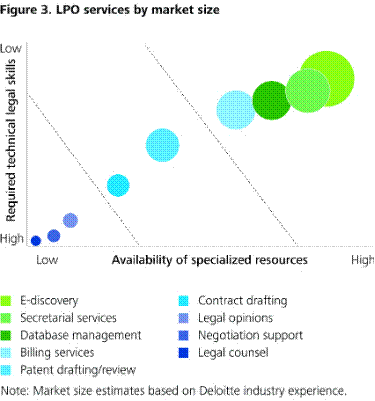
According to The LPO Program, the Global LPO market is expected to grow 34% ($217m) in 2011, from a base of $640m in 2010, to $857m. Corporate legal departments followed by UK-based law firms and US law firms are very active in the market. According to Research and Markets the global legal process outsourcing (LPO) market was worth $400m in 2010 and is expected to be worth $2.4bn by 2012. The Forrester report estimates the global market for legal services to be $250 billion with the US accounting for more than two-thirds of the market, the vast majority of which comes from U.S. companies and law firms ($170 billion). LPO includes include legal research, case briefing, para legal services, documents management, case research and study etc. The charts below highlight ValueNotes estimates and Evalueserve estimates respectively.


 According to NASSCOM-CRISIL study, LPO in India with a share of 17.5 per cent of total KPO market, i.e., USD 356.5 million, in FY2010, is the fastest growing segment, driven by impetus from a post-recession environment characterized by higher bankruptcy cases, regulatory compliances, and cost pressures. Legal Process Outsourcing is also expected to record robust growth to a USD 1.3 billion market by 2015. According to eprobe research Indian legal process outsourcing (LPO) industry was valued at USD 640 million last year and is expected to grow to USD 4 billion by the end of 2015. According to Evalueserve, there are over 5,200 professionals in the LPO industry in India and the Philippines, contributing an annual revenue of USD 300 million, and this is expected to reach 18,000 professionals with an annual revenue of USD 960 million by December 2015.

India is commonly preferred destination for LPO and hold around 85 percent of the market share, with advantages like cost savings, similarity in legal systems of both the US and UK legal system, availability of 1.8 million lawyers as skilled manpower with English proficiency and ‘time factor’ which is time zone advantage. Quality of the legal professionals, ethics and regulatory policies are some of the key challenges. US law firms are very active in the market, but continue to be cautious relative to their UK counterparts but some US law firms are shaking off that traditional caution. Law firms can reduce the overhead expenses cost which constitute 17% of total cost by approximately 10%. India is likely to face challenges from the emerging LPO destinations such as Philippines, Kenya, Mauritius and South Africa.

The Indian LPO space is controlled by exclusive LPO service providers such as Pangea3, CPA Global, Unitedlex, Integreon and Evalueserve which are large players with 500 lawyers. Pangea3 is expected to have annual revenue of $25-30 million. CPA Global has a turnover of $1 Bn globally. Integreon has annual revenues of $100 million. Large Indian players like TCS, Infosys and Wipro have entered into LPO market and are investing for future revenue growth in this segment.

Infosys LPO engagements account for 60 per cent of the total KPO business, with over 500 professionals and Rs. 70 crore ($15 million) in annual revenue. Bulk of the work is done from Pune, followed by Bangalore and Gurgaon. According to media reports Infosys plans to start LPO service delivery from Manila, Philippines, by the end of 2011. Wipro Technologies provide legal process outsourcing (LPO) to Microsoft’s intellectual property (IP) and licensing group worldwide. It has been providing US patent and trade marking filing and docketing services to Microsoft’s IP and licensing group since July 2008.

HCL Technologies is another major player and it has been doing well in LPO since last 4 years. TCS does not have a major presence in the LPO segment but is planning to explore the Legal Process Outsourcing (LPO) market. The company has in fact already begun the LPO services on a smaller scale with very few clients and is hoping to compete with its business rivals Infosys and Wipro who already have a share in the multi-billion LPO market. Cognizant debuted in the LPO space just two years ago initially by reviewing contracts for our financial services clients. The company has since graduated to regulatory reporting, disclosure-related processes, and anti-money laundering compliance.

LPO services go beyond simple cost-cutting and focus more on the quality of services like Litigation and business document review, contract management, electronic discovery, legal analytics and document preparation etc. There are still very few offshore legal service providers that provide specialized high end legal services. With demand for LPO on rise, bigger players will enter into market and the outsourcing of specialized high-end legal outsourcing and variety of legal work outsourced in large amounts will definitely attract new players into the market. Post recession large US law firms are also outsourcing the legal work to India; earlier it was large companies that use to outsource their legal departments. LPO industry is expected to grow in the next five years with revenue growth of 26% annually.

Source: Deloitte - The resurgence of corporate legal process outsourcing


Tuesday, November 15, 2011

India KPO Industry 2011 - Growth Forecast till 2015


KPO refers to process of outsourcing knowledge intensive tasks and functions and India is a dominant player in this market with 70% market share. Indian KPO players offer market research, data analytics, legal services, content and publishing services, pharma data processing etc. Evalueserve estimates Global KPO industry to grow to $ 17 billion by 2014, from current $9 billion in 2011 and is expected to grow at an annual rate of approximately 24% for the next four years (2010-14).

Chart: 1 Global KPO Industry Market Size and Number of FTEs (2006-2014)

KPO firms in India would employ approximately 205,000 professionals generating revenue of $ 10 billion by 2014 from current $ 5.95 billion and 135,000 professionals in 2011. Evalueserve predicted Global KPO market will reach $17 billion revenue by 2011 in 2005. KPO market slowed down due to the Global financial crisis. With tough competition form Latin American, Eastern European and some Asia Pacific countries, India KPO market is expected to grow by 20% annually lower than KPO industry annual growth rate of 24%. But India is expected to retain its dominant position in near future.

Chart: 2 India KPO Industry Market Size and Number of FTEs (2006-2014)

NASSCOM estimates on KPO Market
According to Nasscom-Crisil study, knowledge services outsourcing industry in India is expected to grow at a CAGR of 22.2% over 2015 from $2 billion in 2010 and touch $5.6 billion. Globally, knowledge services landscape is expected to grow from $2.9 billion in 2010 to $7.9 billion by fiscal 2015. Business research would continue to be the most widely adopted service line with a 39.4% share, representing a $2.2 billion opportunity. Share of data analytics, on the other hand, is expected to increase from 18.5% to 20.6% ($1.15 billion) over the same period. Legal Process Outsourcing is also expected to record robust growth of $1.3 billion by FY15. In terms of verticals, financial services would continue to be the largest contributor with a 32% market share ($1.4 billion), followed by healthcare at 19.5% and hi-tech and telecom and retail at 13% each.

ASSOCHAM estimates on KPO Market

The Associated Chambers of Commerce and Industry of India has projected KPO industry’s size growing to US$ 8 billion in 2011 and 10 billion mark by 2012 with a growth rate between 25-27%. Currently, the KPO size is estimated to be around US$ 5.7 billion and the sector has grown at around 15-17% in last few years. According to ASSOCHAM, domestic KPO industry is facing stiff competition from countries like Philippines, Russia, China, Poland and Hungary as these are emerging strong contenders.
Advantage India in KPO

Indian KPOs have significant competitive advantages in terms of low-cost offerings, skilled manpower with sales and marketing capabilities, domain expertise and knowledge of regulatory compliances. Highly educated professionals in engineering, medicine, management, accountancy, company secretary, legal fraternity are available in India. The Indian KPO providers offer a range of solutions to various industry segments such as FMCG, engineering, automobile, telecom, R&D, BFSI, etc. Specialized professionals with specific domain knowledge, problem solving and analytical skills and experience are required who demand 15-20% higher salaries that BPO professionals.

With tight SLAs and quality services, Indian KPO vendors deal with confidential data, including financial data, treasury and cash management functions and investment portfolio decisions. Indian KPO Vendors not only ensure safety of confidential client data but also have better work tools and processes, more sophisticated client centricity, higher billing rates and more domain focused organizations.

India KPO Industry - Future Concerns

The KPO industry was affected by Global financial crisis that caused significant slow down in revenues and presently KPO industry is maturing. The range of services has expanded from initial research and analytics. And as the market has developed, variety of offerings such as legal process outsourcing and clinical trial management are included. KPO industry is also facing the challenge of adequate talent availability and high attrition rate among young professionals. Skills shortages particularly relating to pharma clinical trials etc are major concern in India KPO. Wage inflation is another cause as India is loosing out on the lower cost advantage.

Investments are to be made in developing the infrastructure, buying tools and technologies, develop risk management and to protect confidential client data. The KPO market is expected to grow significantly in coming five years and so is competition from other countries, In Asia Pacific, China, Philippines and Sri Lanka are becoming viable destinations particularly for Pharma, healthcare and Accounting related KPO respectively. Russia and Eastern European countries like Poland, Hungary are also emerging as attractive KPO destinations for engineering and design related KPO. Near shoring is advantageous for Latin American countries as they are near to US and Canada.

Current European debt crisis and US Economic slowdown are causing concern for India KPO industry. Global Financial crisis in 2008 had a drastic affect on the industry where clients cut down spend and KPO industry slowed down and missed its revenue targets. India KPO vendors are gearing up to such a scenario with reducing prices, improving the skill sets, investing in new technologies and looking for high end work that is going to help the clients to overcome slowdown and crisis. Particularly there is focus on improving and acquiring the Pharma, healthcare and life sciences related skills and professionals as significant investments are announced by US and other governments.

India KPO Vendors understand the challenges that exist and they are developing the necessary strategies and acquiring the relevant skills to overcome short term challenges and significantly grow revenues in long term. 


Monday, November 14, 2011

India IT Spend Forecast – 2008 - 2014


According to Gartner, India information and communication technology (ICT) spend is forecasted to reach $71. 9 Billion. By 2011, a 10.3 percent increase from 2010 spending of $65.23 billion and expected to grow with CAGR of 10.9% and reach $95 billion by 2014. Hardware (CAGR 20.4%), Software (CAGR 13.4%), IT Services (CAGR 17.1%) and Telecom (CAGR 7.9%) will drive growth in spending. CAGR is for 2009-2014. Hardware growth is driven by rise in demand of computing needs of people both in rural and urban. IT services growth will be driven by Government and defense segments, large systems integration projects for application services and managed services around IT. Software segment is expected to grow with business intelligence, middleware, database management systems (DBMS) and application development (AD) tools. Verticals like manufacturing, retail, transport and hospitality, government, telecom, financial sectors and IT services will drive IT spend growth. Chart- 1 – Source - Gartner


IDC India IT Spend forecast 2008-2013

According to IDC, from the end of 2008 to the end of 2013, IT spending will grow 11.8% a year, compared to GDP growth of 7.1% a year. Overall IT spending is expected to reach Rupees 1643 billion by 2013 with a CAGR of 11.8%. IT Hardware (CAGR 9%), Software (CAGR 15.2%) and IT Services (CAGR 16.4%) is expected to drive growth. The growth in IT spending will be driven by demand for computing by citizens, businesses and government organizations. Demand across verticals like Banking, Government, manufacturing, retail, telecom etc will drive growth in IT Spending.  IDC is expecting growth in India IT spending despite the current economic crisis and emerging markets are expected to drive growth in Global IT spending. Chart -2 Sources: IDC