Showing posts with label IT budgets. Show all posts

Friday, January 3, 2014

Global Technology Market 2014 – IT spending worldwide expected to be better

Forrester Research predicts global technology market will grow by 6.2% to $2.22 trillion in 2014, fueled by an improving economy and growing interest in areas such as mobility and cloud computing and the market is dominated by United States followed by Europe that is slowly recovering from recession and even BRIC countries (Brazil, Russia, India and China) too are recovering from sluggish economic growth and Latin America and Eastern Europe, the Middle East, and Africa are expected to do well. The report forecasts technology spending is expected to grow in Brazil (11.6%), Mexico (10.1%), at 11.6% and 10.1%, China and India are also expected to grow 7.7 % each.

According to Forrester analysts growth will pick up pace in 2015 and forecasted to grow by 8.1%. “Tech Twelve country (Canada, the US, Denmark, Finland, the Netherlands, Sweden, Switzerland, the UK, Israel, Australia, Singapore, and New Zealand) CIOs can be more aggressive in their budget plans. Businesses and governments in these countries are eager to embrace new technologies and feel competitive pressure to do so given the pace of adoption by competitors in their own and similar countries,” the report said.

Software will account for the largest share of tech spending in 2014, at $568 billion, followed by IT outsourcing at $442 billion, IT consulting and integration services at $421 billion, computer equipment with $416 billion and communications equipment at $373 billion, according to Forrester's report. CIOs will focus their biggest spending increases on software, where growth globally will be 7.1% (in local currency terms) in 2014 and 10.2% in 2015. Analytics, applications and software-as-a-service (SaaS) applications are expected to see the fastest growth of any IT spending category. IT consulting and implementation services will also raise in line with higher software spending, according to Forrester Research.


Forrester Analysts led by Andrew Bartels expect hardware sales to trail behind software but the tablet market is expected to perform well dragged by slow and modest growth in laptops and PCs. The report also notes that spending on technology such as software as a service, mobile devices and tablets, platform-as-a-service (PaaS); smart computing and big data, real-time predictive analytics and big data tools will grow in 2014. IT outsourcing will be one of the weaker segments in 2014 and it will pick up in 2015, according to the report. Global technology market had seen a tough demand conditions in the past two years and the growth rates had been low which is expected to slightly pick up in 2014 and analysts predict a good growth in 2015. Economic and political instability in many countries across the globe are also a major concern for the technology market growth. Indian market will also see sluggish growth as there is General elections this year and political instability is major concern for the economy. 

Monday, July 15, 2013

Worldwide IT Spending 2013 -2014 Gartner reduced due to currency fluctuations & PC Sales

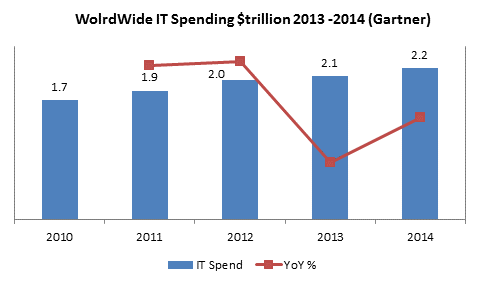
Worldwide IT spending is projected to total $3.7 trillion in 2013 including Telecom Services, a 2 percent increase from 2012 spending of $3.6 trillion, which is half of what Gartner forecasted earlier at the beginning of 2013 in first quarter in U.S. dollars was 4.1 percent. The 2.1 percentage point reduction was forced due to the recent fluctuations in U.S. dollar exchange rates; growth in constant currency is forecast at 3.5 percent for 2013, down only slightly from last quarter. With the Indian rupee falling to record lows, from Rs 54 at the beginning of 2013, it touched Rs 60 against the US dollar Indian companies have reduce their IT budgets as most of the Software, Hardware and Services are imported and are paid for in US dollars. Most of the emerging market currencies have depreciated significantly against dollar which forced Gartner to reduce the IT spending for 2013. Excluding the Telecom services the Global IT Spending is estimated to reach $ 2.068 trillion in 2013 and $ 2.181 trillion in 2014. Apart from the currency fluctuations, the big decline in the forecasting of devices led to significant fall in growth and the forecast for spending on devices in 2013 has been revised down from 7.9 percent growth in Gartner's previous forecast to 2.8 percent.

Within the devices segment majority of the decline is in PC sales, which was highlighted both in the first quarter and second quarters of 2013, with little recovery expected during the second half of 2013. Personal computer sales is hit hard by both the Tablets and the smartphones both at the high end and mid end and both tablets and smartphones are offering equivalent computing power that is offered by a laptop or desktop and customers are using these mobile devices more to browse internet, access email and Social networking sites through mobile devices. While new personal computers particularly laptops that are sleek in design and with touch screen capabilities are expected to be launched in the second half of 2013, they will fail to gain market share due to the underlying weakness of the traditional PC market.


Tablets and Smartphones are expected to keep up the growth rates as highlighted by the outlook for tablet revenue for 2013 is 38.9 percent growth, while mobile phone revenue is projected to increase by 9.3 percent. Enterprise software spending is on pace to grow 6.4 percent in 2013 within which growth forecast for customer relationship management (CRM) have been raised as its adoption expanded coverage into e-commerce, social and mobile. Expectations for digital content creation and operating systems have been reduced as software as a service (SaaS) and changing device demands impact traditional models and markets. Overall both the macroeconomic volatility and changes in the technology trends are impacting the IT spend in 2013 and expected to have significant impact in 2014 too.

Tuesday, December 25, 2012

Indian BPO Industry losing its sheen & continue to face tough challenges in 2013

Source: NASSCOM . FY2012-13 estimated is self estimate.
With diminishing cost arbitrage and margins, Indian BPO players are struggling to keep up the growth and last four years (2008-2012), CAGR for the BPO sector has been slow at 12.47% compared to  India’s IT services exports, which posted a 17.23% growth during the same period. With reducing client spends and IT budgets Indian BPO industry is further expected to face tougher year in 2013. Another important reason is that India’s cost advantage as an offshoring destination has dropped by 30-40% and also with high attrition rate (40%-50%) as companies are finding it difficult to hold on to employees who were earlier attracted to the industry but presently resenting the BPOs due to the lack of career growth opportunities and falling compensation, perks, bonuses and benefits, industry is facing problems in fueling growth. There has been significant pressure on the margins too due to wage inflation where in the salaries of the employees have risen fast, foreign exchange losses as most of the revenues are dollar revenues and companies failed to hedge the currency risks and the Indian rupee had been very volatile ranging from `43 to `57.15. Companies like general motors who initially outsourced majority of their business processes and IT processes to India have recently announced to move back the outsourced jobs back to United States.

According to The Hackett Group, offshoring of jobs to India will be declining from 2014, and will reach the end of its lifecycle in eight years, as the traditional model of US and European companies moving finance, IT, and other business services jobs offshore will reach its maturity and there will not be many jobs left out with the companies to outsource to India. According to Nasscom, software services are the fastest-growing segment with 19% growth in FY12, while BPO exports grew at 12% over last year. “Gone are the days of over 30% growth for the BPO sector, going forward it will be in low single-digit,” says TPI’s Pai. The rise of other low cost destinations like Philippines and near shore destinations like Brazil, Argentina for United States and Poland for Europe have been successful in attracting outsourcing business through quicker response time, better technical support and near-shore advantages. Despite the low cost advantages these low cost locations cannot match India in terms of economies of scale, large pools of skilled talent and workers, experience and technical knowhow and ability to deliver large scale projects. But most of the Indian BPO vendors are not agreeing with the Hackett Group view that Indian BPO will be reaching maturity and they are focusing on improving their product and service offerings and move up the value chain.

Indian BPO vendors like Genpact, WNS, Infosys BPO, TCS BPO, HCL Tech BPO, Aegis, etc. are struggling to keep up their revenues and margins. Industry leader Genpact had a very bad Q32012 (despite 14.3% increase in revenues net profit impacted by "foreign exchange re-measurement loss and expenses related to special cash dividend") and the company highlighted the volatile economic conditions and clients cutting down budgets but still indicated that it will expect full-year revenues of $1.86- $1.90 billion, and adjusted operating income margin of 16-16.5% in 2012. WNS which earlier had tough time in keeping up growth was able to attain a 6-7% organic growth and guided double digit growth for 2013 as the company has verticalized their services in domain and have adopted technology-enabled non-linear model for their service offerings. Not only WNS but most of the BPO players in India like Genpact, etc. are moving up the value chain by focusing on Analytics, Social Media, Consulting, Mobility and Cloud computing to boost up margins. Products and Platform based offerings are being developed and aggressively marketed to clients as the Indian BPO vendors are looking to increase nonlinear revenues that are revenues independent of headcount rise. Outcome based pricing models are also being adopted too by Indian BPO vendors despite significant risks and most of the BPOs are targeting 30% revenues from Nonlinear outcome based models in next five years.

Generally BPO is not a high value work mostly clerical type of work which is monotonous and repetitive. BPO is an intense operational game and there is severe competition between the Indian vendors and the multinational vendors like IBM, Accenture, etc. which has led to significant pricing where vendors cannot afford to rise prices and are facing severe margin pressures. There is minimum difference between the service offerings of the various vendors both Indian and Multinational, and the Indian BPO vendors could not expand their service offerings sticking with the low end work and not moving up the value chain to more high end work where they can charge more prices and increase their margins and the Indian BPO industry could not scale up its size. “Today none of the standalone BPO firms are of significant size. They are mostly in the $350-million range, expect for one or two like Genpact,” Sid Pai, partner and MD, TPI India. But the Indian BPO vendors have realized this fact and they have been investing significantly over the past few years in the development of products, platforms, new service offerings, and emerging technologies like cloud computing, mobility, analytics and social media. Multinational BPO players like IBM, Accenture, Dell, Xerox, Cap Gemini, etc. are expanding their BPO operations in India and other Low cost destinations like Philippines, Poland, etc. to offer more services to their clients and reduce costs.

“BPO business has become a big-guy game. Smaller players with niche competencies will get acquired. Like in analytics space, every day you hear firms getting acquired by larger firms. It is a very consolidated game and a big player’s market,” says Genpact’s senior VP Shantanu Ghosh. Accordingly there has been consolidation in the Indian BPO industry like Firstsource Solutions being acquired by Kolkata-based power utility company CESC for about R640 crore. According to industry reports, the Essar Group backed Aegis and WNS are looking for PE funds to scale their businesses. Recently, PE major Bain Capital picked up a 30% stake in Genpact for $1billion. Infosys bought Australia based sourcing and category management services firm - Portland Group Pty Ltd for $37Mn.  Indian BPO has moved beyond “bread and butter” voice and transaction processing and is increasingly looking for higher value-adding activities like KPO (Knowledge Process Outsourcing), which comprises legal research, advisory and consulting services among other offerings.

Genpact acquired Triumph Engineering, which provides engineering and technical services to aviation, energy, and oil & gas industries, Atyati Technologies, a technology platform provider for the rural banking sector in the country, and Accounting Plaza, a provider of finance and accounting, human resources services and ERP services in 2012. WNS has acquired South Africa-based Fusion Outsourcing Services in 2012 for £10 million Fusion provides outsourcing services including contact centre, customer care and business continuity services to both South African and international clients and would look at acquisitions of $5-20 million this year.This clearly shows the Indian BPO vendors are acquiring companies for both the revenue growth and for adding skills and capabilities to increase their service offerings. Most of the Indian vendors are sitting huge cash reserves which they can utilize for acquisitions. Overall there is tough year ahead for the Indian BPO vendors in 2013 and they need to prepare themselves for this by aggressively improving their products and services offerings and also look for increasing their nonlinear and outcome based revenues thus moving up the value chain

Tuesday, June 12, 2012

Global SaaS Market 2012 – Emerging Markets will drive growth till 2015


Software as a Service also known as on-demand software is a delivery model in which software and its associated data are hosted centrally and are accessed by users using a web browser. After more than a decade of use and vast improvements in the cloud computing technologies and many players like Amazon, Google, Saleforce.com, etc, major software vendors, developers and independent software vendors too invested significant resources both in terms of monetary, human and infrastructure to further develop the cloud computing. Initially IBM kick started the trend towards cloud computing with its On Demand computing initiative in 2003 and later in 2005 Amazon took the market forward with its cloud offerings like the Elastic Cloud 2 (EC2).  Even Indian IT Services Vendors and other small & medium players too are focused on cloud computing and particularly in Software as a Service offerings (SaaS). SaaS growth is an alternative to the on premises software and also Cloud-based licensing is different from traditional on-premises licensing and the market growth is only possible by cannibalizing the traditional software market. SaaS was expected to capture significant market share as its adoption benefits range from significant reduction in costs as buyers need not invest on the IT infrastructure on their premises, pay as you use model, easy to scale and upgrade, tighter IT budgets due to economic volatility in recent years and mobility i.e. access from anywhere and with any device.

According to Gartner, worldwide software-as-a-service (SaaS) revenue is expected to reach US$ 22.1 billion by 2015 as many companies are investing in cloud technology and is expected to grow healthily by 17.9% to reach USD 14.5 billion in 2012 from USD 12.3 billion in 2011. North America revenue is forecast to be US$ 9.1 bn in 2012 compared to US$ 7.8 bn in 2011, Western Europe revenue 2012 forecast US$ 3,2 bn compared to US$ 2.7 bn (2011), Eastern Europe (2012) US$ 169.4 million compared to US$ 135.5 million (2011), Asia Pacific (2012) US$ 934.1 mn compared to US$ 730.9 mn (2011), Japan (2012) US$ 495.2 mn compared to US$ 427 mn (2011) and Latin America (2012) US$ 419.7mn compared to  US$ 331.1 mn (2011). According to IDC, SaaS market revenue which includes cloud applications, application development and deployment, and system infrastructure software sales will rise to $53.6 billion by 2015 at a CAGR of about 26%. IDC also asserts that SaaS will grow faster than traditional software and will comprise 80% of the software delivered by new ISVs. By 2015, nearly $1 of every $6 spent on packaged software, and $1 of every $5 spent on applications, will be consumed via the SaaS model. According to Forrester, the public cloud market for SaaS is the biggest and fastest-growing of all of the cloud markets ($33 billion in 2012, growing to $78 billion by the end of 2015). According to market research firm Global Industry Analysts, the global SaaS market will reach $26.5 billion by 2015, as more companies will seek low-cost enterprise software solutions to accommodate limited IT budget growth, which could slow due to the global economic recession.

SaaS market growth is different in different geographies and compared to mature North America market that contributes 2/3rd of the total SaaS market revenues is expected to grow by 16.7% and Western Europe the second best market expected to grow by 18.5% YoY, which is less when compared to 28% YoY growth for Asia Pacific excluding Japan, 27% growth for Latin America, 25% growth for Eastern Europe and Japan too is expected too see low YoY growth of 16% like in the other mature markets. Data highlights that SaaS market growth lies in the emerging markets as the countries in those markets are improving their IT infrastructure and looking to adopt SaaS technologies aggressively. Small and Medium Enterprises (SMBs) are driving the growth when compared to large enterprises that find it difficult to migrate to cloud computing from their existing on premise software and hardware systems as they have made significant investments in building these systems for years and due to other concerns like data security integrity, privacy, skilled man power, pricing and contracting issues, regulations, etc.  SaaS has become a common delivery model for most business applications, including accounting like expense management, financials, collaboration, customer relationship management (CRM), management information systems (MIS), enterprise resource planning (ERP), invoicing, human resource management (HRM), content management (CM) and service desk management.

Asia Pacific is high growth market for SaaS and this is driven by increased adoption in India, China driven by adoption of financial applications like accounting. ERP functions like Expense management and Employee Performance management, along with office suites, email and CRM sales are the other applications that are being deployed by companies in this region. Mature economic countries in this region like Australia, New Zealand, Hong Kong, Singapore, South Korea and Taiwan are driving SaaS adoption as they have good IT infrastructure that encourages increased adoption. Emerging countries in this region like Malaysia, Thailand, Indonesia, Philippines, and Vietnam where IT infrastructure is developing fast are also expected to increase SaaS adoption. Japan was affected by the 2011 earthquake and Tsunami but SaaS market is gaining traction as Japanese companies are looking at SaaS as a defense against future power outages and disasters but there are concerns in terms of security, costs, and integration. Despite Japan economic problems and tighter IT budgets the demand for SaaS solutions is increasing due to their lower implementation costs and faster deployment times. SMBs too are driving growth and according to AMI Partners, SMB focused market research firm, forecast that the SaaS market in Asia/Pacific (excluding Japan) will reach $1.5 billion by the end of 2012 and expects the market to more than double by 2015.

Expense management, financials, email and office suites are the business apps deployed through SaaS and Web conferencing is also highly used as most of the American companies have global operations situated across the world but the market is also facing problems in terms of limited flexibility of customization and limited integration to existing systems according to Gartner. Gartner analysts said in Western Europe, the most developed sub region, SaaS Market is rapidly increasing as North America-based SaaS vendors further penetrate the region and the number of local European SaaS vendors increases. In Eastern Europe and the Middle East and Africa, which are small and emerging markets overall, the potential opportunity for SaaS is more in the medium to long term due to ongoing infrastructure challenges that vendors need to overcome if they are to be successful in these regions. In Latin America, SaaS has been deployed in the areas of email, financial management (accounting), sales force automation and customer service, and expense management. While regional adoption will be positive, it is fully expected that Brazil and Mexico will drive a majority of adoption and revenue opportunities.