Monday, October 7, 2013

Healthcare Outsourcing 2013 – Indian IT Vendors current scenario & Outlook 2020

Cognizant Technology has a far lead in this regard as they moved into healthcare long before and for them Healthcare is the second largest vertical after BFSI. Cognizant is the largest IT services provider in healthcare, earning $1.97 billion from the segment in the year to 31 March 2012, more than three times the $602 million healthcare and life sciences revenue of India’s largest software services provider TCS. Infosys earned $680 million from healthcare, Wipro $615.5 million and HCL $500 million. As on 31 March 2012, healthcare was the second-largest source of revenue, behind only financial services, for Cognizant. It made up 25.2% of the company’s revenue, compared to 11.3% for HCL Technologies Ltd, 5.2% for Tata Consultancy Services Ltd (TCS), 9% for Infosys Ltd and 9.9% for Wipro Ltd. Cognizant ranked sixth in the 2013 ‘Healthcare Informatics 100’ list of healthcare IT services providers by revenue in the US, while Infosys Public Services Inc. a subsidiary of Infosys, ranked 15 and was the only Indian IT services provider to figure in the list.

HCL Technologies has also seen growth in its healthcare revenue, which grew 55.8% in the 12 months to 31 March, and at a compounded annual growth rate of 37.66% in the last three years. The company acquired UK-based SAP consulting company Axon Group Plc., in December 2008, which enabled it to position itself as a system integrator to its life sciences and healthcare clients globally. The company also announced that it will actively engage in new business (accountable care) and technology business models by 2014. The focus areas include healthcare reform and member experience management and testing. Infosys and Wipro are also sharpening their focus on healthcare capabilities. Infosys over the last three years has invested in building several key capabilities in healthcare in the US. Infosys is assisting several clients in multiple opportunity areas: setting up state exchange, onboarding health insurers to public exchanges, end-to-end testing etc. according to Eric Paternoster, chief executive officer and president, Infosys Public Services.

Sangita Singh, senior vice-president and head, healthcare and life sciences, Wipro said Company strategy is to focus on select few customers to co-create solutions that can drive patient-centricity and reduce costs. There is, therefore, a huge thrust on domain-specific solutions, combined with Wipro’s strongholds of infrastructure services, BPO (business process outsourcing) and custom apps. Indian outsourcing companies have mostly focused on presence in the health insurance sector but not in the provider (hospital) market. There has been a significant slowdown in health insurance sector which forces Indian vendors to look at healthcare provider market where they have not been able to make a dent in the provider market, which is growing rapidly. The established players make $50- 60 million from each large EMR implementations in the provider segment. Healthcare outsourcing in India is growing at about 31% and is expected to reach USD 280 billion by 2020 and the global healthcare BPO market is growing at a CAGR of over 21%. Healthcare BPO offers tremendous opportunity to companies in India, according to Talent Neuron blog post. 

India Business Process Management Industry 2013 – BPO Industry rebranding

NASSCOM, IT Industry Body in India is working to rebrand the Indian Business Process Outsourcing Industry to Business Process Management Industry which is a difficult task as it still needs to convince clients, job aspirants and other stakeholders. The BPO is often associated with low-end work night shift based typical call centres selling credit cards and insurance policies to foreigners. India's BPO services industry accounts for 38 per cent of the global market.But Indian BPO industry has moved away from this low end work to high end work involving analytics, MIS, Knowledge process outsourcing, legal process outsourcing, Healthcare and medical related work. This has led to the rebranding exercise by NASSCOM for creating a stronger image for Indian BPO Industry that will improve its identity as a full-service value provider that specializes in providing performance-based services.  India's BPM industry directly employs about 1.1 million people and this figure will touch 1.8 million by 2020. The sector is expected to grow to USD 50 billion by 2020 from USD 20.8 billion in 2012-13 fiscal at a compounded annual growth rate of 13 per cent, according to NASSCOM.

Global BPM sourcing market is currently valued at about USD 150 billion and India is expected to capture major share of this industry and Indian IT-BPO players are well equipped, as they have built the necessary technological expertise in Business Process as a Service (BPaaS), automation, IT-BPM interplay, etc. India’s BPM industry has changed its pricing models wherein it offers tailored pricing models like outcome based pricing model, according to client requirements, according to NASSCOM President Som Mittal. Already, the industry had moved to a non-linear trajectory. "The industry's growth from $18 bn to $20 bn was non-linear as people addition was far less compared to the normal course," according to Raman Roy, founder of BPM firm Quattro and who is regarded as one of the pioneers of India's BPO industry. Domain specialists in sectors like healthcare and retail will be the growth drivers for India's business process outsourcing (BPO) services industry, according to industry body NASSCOM. Nasscom president Som Mittal said the association was launching an outreach program that engages with various influencers, including academia and parents, about career options in the BPM industry.


Indian BPO Industry has been developing transformational outsourcing models that are more integrated with IT technologies and delivering clients huge value benefits and are also impacting the business outcomes of their clients. Higher end work in the areas of analytics, market research, MIS, customer relationship management, social media marketing, etc. and highly specialized work related to LPO, Healthcare outsourcing is also being outsourced to Indian vendors like Genpact, WNS, TCS BPO, Infosys BPO, HCL BPO, etc. Mergers and Acquisitions are also increasing as the Indian BPO players are looking to acquire new skills and technologies and offer them to clients that will not only increase their revenues but also increase their profitability. They are also establishing near shore development centers in Mexico, Brazil, etc and also in eastern European countries like Poland, etc. Indian BPO Industry has transformed into BPM Industry and looking to continue its growth trajectory. 

Sunday, October 6, 2013

India Datacentre Market 2013 – Significant growth expected till 2016

Data Centres are facilities that house computer systems and store data - are of two types captive (firms setting up centres for their own use) and third-party (outsourced).Data centres market in India is seeing a good growth since past few years thanks to the explosion of data through smartphones, social networking sites and ecommerce companies. Even Government of India have initiated projects like Aadhar Card project by Unique Identification Authority of India, digitization of Land records, citizen services, etc. are also increasing the demand for data centres in India. In India market is dominated by third-party data centre providers like Netmagic, Tulip Telecom, CtrlS and telecom firms Reliance, Tata Communications and Sify that provide services to internet companies like Yahoo, Ebay, Flipkart, Myntra, etc. According to Nasscom, India’s data centre market was at about $2.2 billion in 2012 and is estimated to grow by more than 8% over the next 3-4 years. The current data centre space available is India is about 3.7 million sq ft as of 2012-end and is estimated to rise to 6.3 million sq ft by 2017, said Naresh Singh, Principal Research Analyst with Gartner, with service providers leading majority of the growth. In terms of market size, it is projected to grow to $3 billion (Rs 16,320 crore) from $2.2 billion (Rs 11,960 crore) in the same period. Data centre capacity is concentrated across certain cities such as Bangalore, Mumbai New Delhi and Hyderabad. Gartner valued the colocation and hosting market in India at US$609.1m in 2012 and by 2016 it will be worth $1.3bn.


The Date Centre Dynamics Intelligence Industry Census data collected in 2012 shows that investment in India’s data centre market was expected to reach US$4.4bn in 2012, up from $4.1bn in 2011 (China investment for 2012 was expected to be $8.7bn and Brazil’s $5.5bn). In India, this represents 1.21m sq m of data centre space being built – up from 0.76m sq m in 2011, and a power demand of 1.04 GW in 2012. A report by Frost & Sullivan which predicted that by 2018 there will be almost nine million square feet of data centre floor space — a three-fold increase from current levels. Most of the demand for data centres in India is from IT and IT-enabled service firms, banking and financial services sector, telecom companies, Internet service providers and consumer goods firms. The Indian IT infrastructure market, comprising of server, storage and networking equipment, will total $2.1 billion in 2013, growing 9.7 percent compared to 2012, according to Gartner, Inc and market is driven by hardware refresh, optimization and consolidation efforts and new data centre build. But the industry is facing severe problems like unpredictable power supply which will lead to shutdown of datacenters that costs in terms of money and data loss, unreliable internet connectivity, limited bandwidth and unreliable optical fiber connectivity between different parts of the country.  Despite these problems the demand for data centres in India is expected to grow because of the national e-governance projects by Central and State government and prospective changes in regulations by Reserve Bank of India planning to make it mandatory for data to reside within the geographic boundaries of the country. Even Indian companies are looking to increase the usage of Third Party Data centres as they also need to store data that they are collecting during their business activities and use such data for business decision making.

Monday, July 15, 2013

Worldwide IT Spending 2013 -2014 Gartner reduced due to currency fluctuations & PC Sales

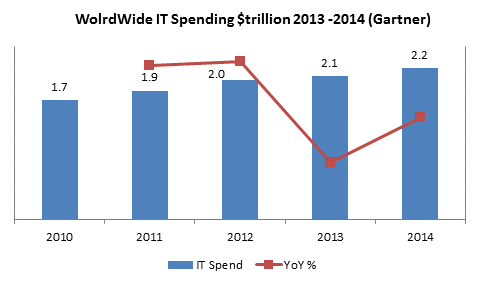
Worldwide IT spending is projected to total $3.7 trillion in 2013 including Telecom Services, a 2 percent increase from 2012 spending of $3.6 trillion, which is half of what Gartner forecasted earlier at the beginning of 2013 in first quarter in U.S. dollars was 4.1 percent. The 2.1 percentage point reduction was forced due to the recent fluctuations in U.S. dollar exchange rates; growth in constant currency is forecast at 3.5 percent for 2013, down only slightly from last quarter. With the Indian rupee falling to record lows, from Rs 54 at the beginning of 2013, it touched Rs 60 against the US dollar Indian companies have reduce their IT budgets as most of the Software, Hardware and Services are imported and are paid for in US dollars. Most of the emerging market currencies have depreciated significantly against dollar which forced Gartner to reduce the IT spending for 2013. Excluding the Telecom services the Global IT Spending is estimated to reach $ 2.068 trillion in 2013 and $ 2.181 trillion in 2014. Apart from the currency fluctuations, the big decline in the forecasting of devices led to significant fall in growth and the forecast for spending on devices in 2013 has been revised down from 7.9 percent growth in Gartner's previous forecast to 2.8 percent.

Within the devices segment majority of the decline is in PC sales, which was highlighted both in the first quarter and second quarters of 2013, with little recovery expected during the second half of 2013. Personal computer sales is hit hard by both the Tablets and the smartphones both at the high end and mid end and both tablets and smartphones are offering equivalent computing power that is offered by a laptop or desktop and customers are using these mobile devices more to browse internet, access email and Social networking sites through mobile devices. While new personal computers particularly laptops that are sleek in design and with touch screen capabilities are expected to be launched in the second half of 2013, they will fail to gain market share due to the underlying weakness of the traditional PC market.


Tablets and Smartphones are expected to keep up the growth rates as highlighted by the outlook for tablet revenue for 2013 is 38.9 percent growth, while mobile phone revenue is projected to increase by 9.3 percent. Enterprise software spending is on pace to grow 6.4 percent in 2013 within which growth forecast for customer relationship management (CRM) have been raised as its adoption expanded coverage into e-commerce, social and mobile. Expectations for digital content creation and operating systems have been reduced as software as a service (SaaS) and changing device demands impact traditional models and markets. Overall both the macroeconomic volatility and changes in the technology trends are impacting the IT spend in 2013 and expected to have significant impact in 2014 too.

Sunday, July 7, 2013

Legal Process Outsourcing Industry in India targeting to reach US$ 1 billion by 2015

Legal Process Outsourcing Industry often termed as LPO industry is targeting to reach US$ 1 billion in revenues in the next two years from the present levels of US$ 440 million. Of course this seems to be an extremely ambitious target as India is no longer the only preferred destination for outsourcing and countries like Philippines, etc. too have emerged as the best alternative destination for outsourcing. More and more business organizations across the globe are looking to outsource to only those countries that not only offer low prices but also have the necessary infrastructure in terms of qualified human resources, information technology and government support. But India is still considered to be the first choice for the Law firms in US and UK that wish to outsource legal services as India has more than 950 law schools that train approximately 60,000 law graduates and qualify them to join the legal profession who will join the 1.2 million registered advocates in the country. Many of the new law graduates prefer to join the LPO firms and the corporate sector rather than opt for judicial clerkship or litigation practice. The number of LPO firms has increased to 140 from around 50 in 2005 and this has led to increased opportunities for law graduates and these firms offer very good salaries. Litigation and judicial clerkship requires a lot of struggle to establish reputation which students today prefer to avoid, but many industry experts and seasoned lawyers believe that finally all the law graduates have to at some point go to courtroom and practice.

Indian LPO firms offer services like reviewing documents and basic due diligence, to automation and process efficiency, review contracts, process loans, provide expert witness advice on data-collection, draft patent applications and conduct litigation-readiness assessment, etc. One of the major challenges for the LPO industry is that every country has a different legal system and the LPO firm employees have to be trained accordingly and Indian law is mostly based on the British Legal system so there is a basic understanding of the British law and they can also easily understand the American Law too which is major competitive advantage for Indian Lawyers.  Another crucial factor is the low cost and subsequent low pricing that Indian firms offer, for example for drafting contracts and legal memos a US Lawyer can charge somewhere between US$ 300-400 per hour but in India same work can be done with US$ 10-30 per hour. This is a major cost advantage for the US and UK law firms and corporate legal departments in business organizations who need to cut costs constantly to survive. The availability of skilled lawyers along with the government support the LPO industry is hoping to cross the billion dollar revenue mark in the next couple of years. Most of the private Universities and big educational groups in India are offering dual degree programs like BBA-LLB, BA-LLB and are also offering Masters Programs in Law with specialization focused on Intellectual property rights, financial and Business laws, etc. which will also help the LPO firms to offer even more specialized services to their clients. Many law students are coming from middle class families who take educational loans for studies and Indian Law firms are majority family owned Law firms which do not provide much opportunity for fresh graduates and everyone cannot enter into Judicial services, corporate legal departments and practice litigation, the only option they have is Legal Process outsourcing firms.  

Sunday, June 30, 2013

Finance & Accounting Outsourcing market maturing & seeing stable growth in 2013

According to Everest Group, Financing and Accounting Outsourcing: Annual report 2013, the global multi-process FAO market grew at the rate of 10% to reach ACV of US$4.3 billion which highlights the fact the market is matured and stabilizing and is further substantiated by the fact that over 65% of the ACV growth in 2012 was contributed by contract extensions/renewals. Cost reduction and process improvement are the primary drivers for adoption but standardization, scalability and flexibility drove FAO adoption further, emphasizing a cost+ value proposition highlights the Everest Group report. As the traditional markets matured the vendors are forced to move to under-penetrated markets but Europe led the market increased FAO adoption and mid-market and small buyer segments also increased their adoptions significantly in 2012 led to moderate growth in 2012. Competition in the FAO market is intensifying as the share of the top three service providers declined from 68% in 2002 to ~50% in 2012. Some of the key players in the FAO market are Accenture, Aditya Birla Minacs, Aegis, Capgemini, Cognizant, Datamatics, EXL Services, Genpact, HCL, HP, IBM, iGATE, Infosys, IQ BackOffice, NCO, Quatrro, Serco, Steria, Sutherland Global Services, TCS, Wipro, WNS, Xchanging, and Xerox. ( Data Source: Everest Group)


One of the significant trends is the rise in Adoption of end-to-end process but buyers continue to remain cautious and adopt a phased approach to F&A outsourcing. Some of the new focus areas that are emerging are Analytics, risk management & compliance and F&A services are increasingly getting industry-specific. The Everest report also highlights buyers are increasingly adopting non-advisor-led competitive bidding route for sourcing F&A services. India continues to be the predominant hub of offshore delivery and most of the vendors both global and Indian are striving to build a balanced onshore-nearshore-offshore model. Technology augmentation model is becoming the predominant approach where in the vendors are developing technology infrastructure and also adopting emerging technologies like cloud computing, mobility, social media and big data analytics to offer innovative service offerings to clients. Outcome based pricing model and platform-based solutions are also gaining traction. Service provider performance is up-to-the-mark against the metrics important to FAO buyers, resulting in high satisfaction levels. However, buyer organizations have highlighted some areas of improvements for service providers to work upon. Vendors are shifting their focus to building technologies and service offerings through adoption of emerging technologies like cloud computing and offer cloud-enabled F&A technology that can be delivered as a BPaaS solution.

Saturday, March 30, 2013

Major Healthcare related acquisitions by Indian IT/BPO Vendors


US Healthcare Reform (Obamacare) – Big opportunity for Indian IT Outsourcing vendors in Healthcare Outsourcing

The US healthcare outsourcing market is currently estimated to be about $20 billion, according to outsourcing advisory firm Everest Group. Indian IT Vendors are targeting major chunk of this business worth billions of dollars in the next few years as US Healthcare Services Providers have to upgrade their systems, software and other infrastructure by January 1, 2014, when President Barack Obama’s landmark legislation Patient Protection and Affordable Care Act, popularly known as Obamacare will come into effect, which would result in United States spending $2.5 trillion. Obamacare seeks to extend insurance to country’s poor, which would extend insurance cover to 32 million Americans and also targets to reduce healthcare costs significantly and one way of reducing costs is outsourcing to countries like India and which will open up projects for Indian IT service providers that will help them in keeping up the revenue, margin and industry growth rates. Healthcare providers in North America which also happens to be the world’s biggest software services market are forced to upgrade existing medical systems by deploying newer software applications and they are outsourcing projects to Indian vendors such as Wipro, Cognizant Technology Solutions Corp., HCL Technologies Ltd, etc.

Work that can be outsourced to Indian IT/BPO Vendors include the maintenance and care of health records, conversion to ICD-10 coding, effective collection, management and use of information within healthcare systems, providing innovative healthcare technologies and applications that will help in delivering effective, efficient and low cost healthcare to the people. Indian Vendors have been providing medical coding and transcription services to US Healthcare providers for some time but the billing generated through medical coding is far less than the billing generated by Health care IT Systems projects. US Healthcare reforms will drive revenue growth for the Indian IT vendors in the coming future may be for next 10 years as the traditional strong vertical of Banking, Financial Services and Insurance vertical which contributes 50% of the revenues for the Indian IT Vendors is facing rough times since past few years and expected to face tough and volatile economic conditions for the next few years.

But the question arises whether Indian IT Outsourcing vendors have the necessary resources in terms of skilled professionals, domain experts, technologies and capabilities to service the US Healthcare providers. As highlighted by Jimit Arora, vice president at Everest Group Indian IT Vendors face a major challenges as they lack understanding of the domain solutions and are not familiar with medical terminology that will have  an impact on the ability to translate that into technological solutions and product offerings. But Indian IT Vendors are overcoming this challenge by acquiring the small medium players in the healthcare segment that offer niche product offerings and possess the necessary skills for the Healthcare outsourcing. All the major Indian IT Vendors TCS, Infosys, Wipro, HCL Tech have been eyeing acquisitions in this space since past three years and BPO vendors like Genpact have acquired companies in Healthcare space like Jawood.  But overall the fact is that there is a significant revenue opportunity worth billions for IT companies because of Obamacare and Indian IT/BPO providers are likely to get 40-50 per cent of this revenue.

Sunday, February 24, 2013

Global Legal Process Outsourcing market crosses US$ 1 billion in revenues in 2012

According to a study by LPO program, the global legal process outsourcing market has reached the $1 billion mark and is continuing its growth at an annual growth rate of 32 per cent. According to Global Outsourcing Association of Lawyers blog post on www.kpoconsultants.com, the global spending on legal services is estimated to be around $250 billion. United States alone contributes about two-thirds ($167 billion) in terms of legal services. For law firms and organizations outsourcing of legal services to India can be considered to be a lucrative option but it is not feasible to outsource every type of legal service, hence the market for legal services outsourcing stands at around $111.2 billion. Out of which India can only target only 3.6% ($4 billion) and in reality only 2% ($80 million) has been outsourced till now. This highlights the fact there is a relatively big untapped market available for the Indian LPO vendors and other global LPO vendors to exploit which also helped the industry to cross the billion-dollar mark in 2012. According to a Nasscom market intelligence report, the LPO segment is expected to touch $15 billion by 2015.

The Indian LPO space is dominated by pure play LPO vendors such as Pangea3, CPA Global, Unitedlex, Integreon, Intellevate and Evalueserve. In 2010, Pangea3 became part of Thomson Reuters, the world’s leading provider of intelligent information to legal and business professionals. In the initial days of Legal Process Outsourcing (LPO) to India most of the work used to be backend processing like transcription but the high end work like IP processes, legal research, pre-litigation documentation, document analysis, preparing software licensing agreements is presently being outsourced to India along with the low end work as the Indian LPO vendors have matured and have built the capabilities in terms of skills and hired talented lawyers. One of the important process for companies is the patent filing which is also being outsourced to India  which is known as Patent Process Outsourcing (PPO and the process has more than 900 professionals who are qualified and trained to provide patent related services at a cost of $2,500 compared to $8,000-$12,000 charged by U.S. firms. Currently, the entire Indian LPO sector only employs some 50,000 people, according to Sanjay Kamlani, the co-CEO of New York-based Pangea3.

India already has more than a million practicing lawyers, and another 70,000 new graduates are added every year as they pass out from various law colleges across India and these lawyers are educated in English medium, similarities between Indian Legal System and U.K., U.S., Canada, and parts of Europe, labour cost arbitrage, time zone advantage, experience in providing various types of outsourcing services, and the clear edge that Indian LPO vendors have in terms of cost, quality and turnaround time. Along with the pure play players Indian Outsourcing giants like TCS, Infosys, Wipro all offer LPO services and they work with very prominent US clients. Despite the hype in the past years the Indian LPO industry had been growing steadily but far slower than the other types of outsourcing which are Information technology, Business process, and Knowledge process.  Most of the time the high end work cannot be outsourced and the reliance on the low end work is not highly profitable and to increase the high end work Indian LPO vendors are also setting up onshore centers in United States and United Kingdom. According to ValueNotes, market intelligence and consulting firm the large pure play LPO players are financially strong and they can survive in the industry and grow but smaller pure play LPO players will struggle due to their inability to maintain consistent operating profits, resulting in rising debt levels. Overall Indian LPO vendors majorly the pure play vendors will dominate the Global Legal Process Outsourcing Market and will see steady growth in the next few years.

Table of various services provides by Legal Process Outsourcing Vendors
Low skilled quantitative tasks consist of:
High end qualitative tasks include:
  • Paralegal Services & Legal Coding
  • Corporate Secretarial Services
  • Legal Memo Development
  • Medical & Legal Transcription
  • Document Management
  • Litigation Support
  • Data entry
  • Immigration data analysis and working on labor relations


  • Intellectual Property Rights & IPR
  • Portfolio Management
  • Patent Search & Application drafting
  • TM and Copyright Registration
  • Legal Research/Opinion work
  • Document Review and Analysis
  • Intelligence Services
  • Contracting and Administration


Monday, February 18, 2013

Global Platform as a Service (PaaS) Market 2013 & forecast 2018 market growing


PaaS provides a cloud computing platform and a solution stack that allows developers to create applications and software and test them by utilizing tools and libraries from the cloud services provider. Compared to Software as a Service (SaaS) and Infrastructure as a Service (IaaS), PaaS market is small and slowly picking up and the reason being complexity in adaption and building a standardized PaaS platform from the scratch is very difficult for organizations. According to Markets and Markets, Global Platform-as-a-Service market is estimated to grow from $1.28 billion in 2013 to $6.94 billion in 2018 at a compound annual growth rate (CAGR) of 32.54% in this period. In terms of geographies, North America continues to be the biggest market for PaaS solutions. Worldwide platform as a service (PaaS) revenue is on pace to reach $1.2 billion in 2012, up from $900 million in 2011, according to Gartner, Inc. The market will experience consistent growth with worldwide PaaS revenue totaling 1.5 billion in 2013, and growing to $2.9 billion in 2016.

Along with the large players like Amazon, Google, IBM, etc., small players also emerged in this segment that made the market more competitive and vibrant with new products and services are being offered by the cloud services providers. The need for the businesses to develop new applications, tools and technologies at a low cost have increased the demand for the developers and also for PaaS offerings as most of the developers are looking to PaaS to develop and test new apps and software. Application Development and Maintenance PaaS (ADM PaaS), Business Process Management PaaS (BPM PaaS), Application PaaS (aPaaS), Integration PaaS (iPaaS) and Other PaaS are the segments categorized based on Applications.

According to Gartner, the largest segments within the PaaS market are cloud application platform services (aPaaS), accounting for 34.4 percent of total PaaS spending in 2012; cloud application life cycle management (ALM) services (almPaaS) at 12 percent; cloud BPM platform services (bpmPaaS) at 11.6 percent; and cloud integration services (iPaaS) at 11.4 percent. Gartner predicts that the potential spending in PaaS technologies is an average of $360 million per year from 2011 through 2016.  "The fundamental appeal of PaaS is the opportunity for ISVs (independent software vendors) and IT organizations to create new software solutions with minimal capital expense and without the hassle of provisioning and configuring the underlying infrastructure," said Yefim Natis, distinguished analyst at Gartner. "Too many SMBs (small or midsize businesses), in addition, PaaS offers the chance to take advantage of some state of the art enabling technologies, they otherwise could not afford. Finally, the popularity of SaaS also drives adoption of PaaS for customization, extension and integration of the cloud-based applications."

IDC expects 2013 will see an explosion in industry PaaS (public platform as a service) offerings as the market moves up the software stack and "horizontal" PaaS becomes commoditized by platforms built on open source-based infrastructure. In industry PaaS, cloud-based shared services environments are being tailored to the needs of a specific industry, while additional industry-focused solution developers are developing and deploying a range of industry-targeted value-added solutions and services on these platforms. Examples of emerging industry PaaS include: NYSE Capital Markets Community Platform in financial services; numerous health information exchanges in healthcare; and Johnson Controls' Panoptix App Marketplace in smart energy. (Source: IDC predictions 2013: competing on 3rd Platform)