Wednesday, November 16, 2011

India Legal Process Outsourcing Industry 2011 - Key players and growth forecast


According to The LPO Program, the Global LPO market is expected to grow 34% ($217m) in 2011, from a base of $640m in 2010, to $857m. Corporate legal departments followed by UK-based law firms and US law firms are very active in the market. According to Research and Markets the global legal process outsourcing (LPO) market was worth $400m in 2010 and is expected to be worth $2.4bn by 2012. The Forrester report estimates the global market for legal services to be $250 billion with the US accounting for more than two-thirds of the market, the vast majority of which comes from U.S. companies and law firms ($170 billion). LPO includes include legal research, case briefing, para legal services, documents management, case research and study etc. The charts below highlight ValueNotes estimates and Evalueserve estimates respectively.


 According to NASSCOM-CRISIL study, LPO in India with a share of 17.5 per cent of total KPO market, i.e., USD 356.5 million, in FY2010, is the fastest growing segment, driven by impetus from a post-recession environment characterized by higher bankruptcy cases, regulatory compliances, and cost pressures. Legal Process Outsourcing is also expected to record robust growth to a USD 1.3 billion market by 2015. According to eprobe research Indian legal process outsourcing (LPO) industry was valued at USD 640 million last year and is expected to grow to USD 4 billion by the end of 2015. According to Evalueserve, there are over 5,200 professionals in the LPO industry in India and the Philippines, contributing an annual revenue of USD 300 million, and this is expected to reach 18,000 professionals with an annual revenue of USD 960 million by December 2015.

India is commonly preferred destination for LPO and hold around 85 percent of the market share, with advantages like cost savings, similarity in legal systems of both the US and UK legal system, availability of 1.8 million lawyers as skilled manpower with English proficiency and ‘time factor’ which is time zone advantage. Quality of the legal professionals, ethics and regulatory policies are some of the key challenges. US law firms are very active in the market, but continue to be cautious relative to their UK counterparts but some US law firms are shaking off that traditional caution. Law firms can reduce the overhead expenses cost which constitute 17% of total cost by approximately 10%. India is likely to face challenges from the emerging LPO destinations such as Philippines, Kenya, Mauritius and South Africa.

The Indian LPO space is controlled by exclusive LPO service providers such as Pangea3, CPA Global, Unitedlex, Integreon and Evalueserve which are large players with 500 lawyers. Pangea3 is expected to have annual revenue of $25-30 million. CPA Global has a turnover of $1 Bn globally. Integreon has annual revenues of $100 million. Large Indian players like TCS, Infosys and Wipro have entered into LPO market and are investing for future revenue growth in this segment.

Infosys LPO engagements account for 60 per cent of the total KPO business, with over 500 professionals and Rs. 70 crore ($15 million) in annual revenue. Bulk of the work is done from Pune, followed by Bangalore and Gurgaon. According to media reports Infosys plans to start LPO service delivery from Manila, Philippines, by the end of 2011. Wipro Technologies provide legal process outsourcing (LPO) to Microsoft’s intellectual property (IP) and licensing group worldwide. It has been providing US patent and trade marking filing and docketing services to Microsoft’s IP and licensing group since July 2008.

HCL Technologies is another major player and it has been doing well in LPO since last 4 years. TCS does not have a major presence in the LPO segment but is planning to explore the Legal Process Outsourcing (LPO) market. The company has in fact already begun the LPO services on a smaller scale with very few clients and is hoping to compete with its business rivals Infosys and Wipro who already have a share in the multi-billion LPO market. Cognizant debuted in the LPO space just two years ago initially by reviewing contracts for our financial services clients. The company has since graduated to regulatory reporting, disclosure-related processes, and anti-money laundering compliance.

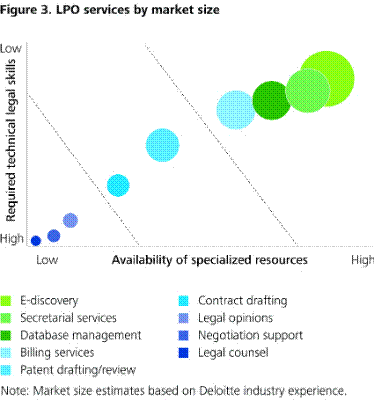
LPO services go beyond simple cost-cutting and focus more on the quality of services like Litigation and business document review, contract management, electronic discovery, legal analytics and document preparation etc. There are still very few offshore legal service providers that provide specialized high end legal services. With demand for LPO on rise, bigger players will enter into market and the outsourcing of specialized high-end legal outsourcing and variety of legal work outsourced in large amounts will definitely attract new players into the market. Post recession large US law firms are also outsourcing the legal work to India; earlier it was large companies that use to outsource their legal departments. LPO industry is expected to grow in the next five years with revenue growth of 26% annually.

Source: Deloitte - The resurgence of corporate legal process outsourcing


Tuesday, November 15, 2011

India KPO Industry 2011 - Growth Forecast till 2015


KPO refers to process of outsourcing knowledge intensive tasks and functions and India is a dominant player in this market with 70% market share. Indian KPO players offer market research, data analytics, legal services, content and publishing services, pharma data processing etc. Evalueserve estimates Global KPO industry to grow to $ 17 billion by 2014, from current $9 billion in 2011 and is expected to grow at an annual rate of approximately 24% for the next four years (2010-14).

Chart: 1 Global KPO Industry Market Size and Number of FTEs (2006-2014)

KPO firms in India would employ approximately 205,000 professionals generating revenue of $ 10 billion by 2014 from current $ 5.95 billion and 135,000 professionals in 2011. Evalueserve predicted Global KPO market will reach $17 billion revenue by 2011 in 2005. KPO market slowed down due to the Global financial crisis. With tough competition form Latin American, Eastern European and some Asia Pacific countries, India KPO market is expected to grow by 20% annually lower than KPO industry annual growth rate of 24%. But India is expected to retain its dominant position in near future.

Chart: 2 India KPO Industry Market Size and Number of FTEs (2006-2014)

NASSCOM estimates on KPO Market
According to Nasscom-Crisil study, knowledge services outsourcing industry in India is expected to grow at a CAGR of 22.2% over 2015 from $2 billion in 2010 and touch $5.6 billion. Globally, knowledge services landscape is expected to grow from $2.9 billion in 2010 to $7.9 billion by fiscal 2015. Business research would continue to be the most widely adopted service line with a 39.4% share, representing a $2.2 billion opportunity. Share of data analytics, on the other hand, is expected to increase from 18.5% to 20.6% ($1.15 billion) over the same period. Legal Process Outsourcing is also expected to record robust growth of $1.3 billion by FY15. In terms of verticals, financial services would continue to be the largest contributor with a 32% market share ($1.4 billion), followed by healthcare at 19.5% and hi-tech and telecom and retail at 13% each.

ASSOCHAM estimates on KPO Market

The Associated Chambers of Commerce and Industry of India has projected KPO industry’s size growing to US$ 8 billion in 2011 and 10 billion mark by 2012 with a growth rate between 25-27%. Currently, the KPO size is estimated to be around US$ 5.7 billion and the sector has grown at around 15-17% in last few years. According to ASSOCHAM, domestic KPO industry is facing stiff competition from countries like Philippines, Russia, China, Poland and Hungary as these are emerging strong contenders.
Advantage India in KPO

Indian KPOs have significant competitive advantages in terms of low-cost offerings, skilled manpower with sales and marketing capabilities, domain expertise and knowledge of regulatory compliances. Highly educated professionals in engineering, medicine, management, accountancy, company secretary, legal fraternity are available in India. The Indian KPO providers offer a range of solutions to various industry segments such as FMCG, engineering, automobile, telecom, R&D, BFSI, etc. Specialized professionals with specific domain knowledge, problem solving and analytical skills and experience are required who demand 15-20% higher salaries that BPO professionals.

With tight SLAs and quality services, Indian KPO vendors deal with confidential data, including financial data, treasury and cash management functions and investment portfolio decisions. Indian KPO Vendors not only ensure safety of confidential client data but also have better work tools and processes, more sophisticated client centricity, higher billing rates and more domain focused organizations.

India KPO Industry - Future Concerns

The KPO industry was affected by Global financial crisis that caused significant slow down in revenues and presently KPO industry is maturing. The range of services has expanded from initial research and analytics. And as the market has developed, variety of offerings such as legal process outsourcing and clinical trial management are included. KPO industry is also facing the challenge of adequate talent availability and high attrition rate among young professionals. Skills shortages particularly relating to pharma clinical trials etc are major concern in India KPO. Wage inflation is another cause as India is loosing out on the lower cost advantage.

Investments are to be made in developing the infrastructure, buying tools and technologies, develop risk management and to protect confidential client data. The KPO market is expected to grow significantly in coming five years and so is competition from other countries, In Asia Pacific, China, Philippines and Sri Lanka are becoming viable destinations particularly for Pharma, healthcare and Accounting related KPO respectively. Russia and Eastern European countries like Poland, Hungary are also emerging as attractive KPO destinations for engineering and design related KPO. Near shoring is advantageous for Latin American countries as they are near to US and Canada.

Current European debt crisis and US Economic slowdown are causing concern for India KPO industry. Global Financial crisis in 2008 had a drastic affect on the industry where clients cut down spend and KPO industry slowed down and missed its revenue targets. India KPO vendors are gearing up to such a scenario with reducing prices, improving the skill sets, investing in new technologies and looking for high end work that is going to help the clients to overcome slowdown and crisis. Particularly there is focus on improving and acquiring the Pharma, healthcare and life sciences related skills and professionals as significant investments are announced by US and other governments.

India KPO Vendors understand the challenges that exist and they are developing the necessary strategies and acquiring the relevant skills to overcome short term challenges and significantly grow revenues in long term. 


Monday, November 14, 2011

India IT Spend Forecast – 2008 - 2014


According to Gartner, India information and communication technology (ICT) spend is forecasted to reach $71. 9 Billion. By 2011, a 10.3 percent increase from 2010 spending of $65.23 billion and expected to grow with CAGR of 10.9% and reach $95 billion by 2014. Hardware (CAGR 20.4%), Software (CAGR 13.4%), IT Services (CAGR 17.1%) and Telecom (CAGR 7.9%) will drive growth in spending. CAGR is for 2009-2014. Hardware growth is driven by rise in demand of computing needs of people both in rural and urban. IT services growth will be driven by Government and defense segments, large systems integration projects for application services and managed services around IT. Software segment is expected to grow with business intelligence, middleware, database management systems (DBMS) and application development (AD) tools. Verticals like manufacturing, retail, transport and hospitality, government, telecom, financial sectors and IT services will drive IT spend growth. Chart- 1 – Source - Gartner


IDC India IT Spend forecast 2008-2013

According to IDC, from the end of 2008 to the end of 2013, IT spending will grow 11.8% a year, compared to GDP growth of 7.1% a year. Overall IT spending is expected to reach Rupees 1643 billion by 2013 with a CAGR of 11.8%. IT Hardware (CAGR 9%), Software (CAGR 15.2%) and IT Services (CAGR 16.4%) is expected to drive growth. The growth in IT spending will be driven by demand for computing by citizens, businesses and government organizations. Demand across verticals like Banking, Government, manufacturing, retail, telecom etc will drive growth in IT Spending.  IDC is expecting growth in India IT spending despite the current economic crisis and emerging markets are expected to drive growth in Global IT spending. Chart -2 Sources: IDC


Sunday, November 13, 2011

India Third Party /Hosting Data Center Market - Major Players


Note: Co-Lo- Co-Location & hosting, MNS- Managed Services, EDC- Enterprise Data Capacity, VAS- Value Added Services. Source: IDC & Company Websites

The third party data center market is dominated by telecom players as they are providing services like broadband and leased lines for the customers and the data center offering will be a value addition service for the clients. Apart from telecom players there are players like Ctrl S who is a specialized data center provider and Sify and Netmagic that are specialized in the internet services. Some small players like Cyquator, ESDS, Net4 with capacities ranging from 10,000 to 20,000 sq ft exist in the market that also offer services to small and medium enterprises. Data centers small or big are all maintaining global standards and getting themselves certified accordingly. Facilities provided are world class.

Wednesday, November 9, 2011

Blue Ocean Strategy adoption by Indian Outsourcing Industry – Examples


HCL Technologies
Vineet Nayar adopted the Blue Ocean Strategy immediately and his four pronged strategy focused on service innovation, pricing innovation, creation of new markets and technology disruption. Also he adopted the policy of Employee First philosophy and full service co sourcing model. The company saw revenue YoY growth of 26 %( 6200Cr) in 2007-08, 41% (8764Cr) in 2008-09, and 25% (10983Cr) in 2009-10 under the leadership of Vineet Nayar as CEO. It has been an up and down performance during the time where financial crisis and recession played a spoil sport. Company still sticks to the Blue Ocean Strategy.

For full article please visit:

Infosys Limited
K V Kamath took over as the chairman of Infosys this year, and talked about a ‘Blue Ocean’ strategy with focus on healthcare and government verticals, and expansion into emerging markets India and China. Infosys revenues from healthcare (1.1%) and government (1.3%) verticals are negligible compared to BFSI (30%), Telecom (15%) and Manufacturing (10%). Healthcare and Government verticals followed by expansion into China and India are the key aspects of the Blue Ocean Strategy.

For full article please visit:

Aditya Birla Minacs 
Aditya Birla Minacs has set a target of US$1 billion in revenue by 2013 and it plans to achieve this through both organic and inorganic routes. To achieve this target company is looking for further acquisitions in FAO space and it is also looking at acquisition in the cloud computing area and infrastructure management segment. The company adopted Blue Ocean Strategy in FAO segment by focusing on three aspects Target Market, Process & Domain Expertise and Technology.

For full article please visit:

Other Blue Ocean Strategy Related posts:

Blue Ocean Strategy Samsung:

Blue Ocean Strategy LG Electronics:
http://analysiscasestudy.blogspot.com/2011/02/blue-ocean-strategy-bos-lg-mobile.html

Tuesday, November 1, 2011

India Outsourcing Industry 2011 – Focus on Healthcare vertical for Growth


Healthcare has become focus vertical for majority of the Indian IT Vendors. Most of the IT/BPO companies like Cognizant Technology, WNS, TCS, Firstsource Solutions, Genpact, Mahindra Satyam, Pacific BPO, CBay Systems, etc already cater to global healthcare industry. Infosys is looking at Healthcare vertical as one of the critical vertical for future revenue growth. Indian IT vendors have been slow in tapping this vertical as major focus earlier was on BFSI and Manufacturing. Indian IT vendors are making use of technology as a platform and offer their service offerings.

US is major market

US healthcare reform announced by President Obama provides a huge opportunity for Indian IT vendors and the policy focuses on controlling healthcare costs and provides universal coverage. The US healthcare bill, valued at US$ 940 billion, will provide healthcare coverage to 32 million Americans over the next 10 years. Currently US healthcare is estimated at $2.5 trillion, which is projected to grow to $4.6 trillion by 2020. Major opportunity for Indian Outsourcing vendors lies in revenue cycle management, electronic medical/health records (EMR/EHR), billing & coding and medical transcription. According to ValueNotes, EMR/EHR is a $20 billion IT outsourcing opportunity. Revenue cycle management (RCM) is a $50 billion market in the US.

Medical transcription business is estimated to be worth $25 billion annually and growing at around 15%. According to CBay Systems the size of the US medical transcription (MT) industry is estimated to be approx. US$17 billion for the year 2011 and is expected to reach US$21.2 billion by 2014. 67% was in-house while the remaining 33% was outsourced. CBay also expects the MT industry in India is expected to touch US$1 billion in 2014 from US$ 435 million in 2009. According to ValueNotes, the MT boom phase is over. Speech recognition technology, being used by most healthcare providers has resulted in shrinking the requirement of a medical transcriptionist’s skills to 10-15% of its original requirement. Medical transcription started in India 15 years ago and India is one of the primary locations and there are number of companies providing end to end medical outsourcing services in India.

Rising Indian Domestic Healthcare Sector

According to a report titled, “India’s New Opportunities- 2020” prepared by the All India Management Association, Boston Consulting Group and the Confederation of Indian Industries (CII), the Indian healthcare sector is poised to reach US$ 280 billion by the year 2020, thereby contributing an expected Gross Domestic Product (GDP) spend of 8 per cent by 2012 from 5.5 per cent in 2009. A US$ 36 billion industry in 2009 and growing at 15 per cent compound annual growth rate (CAGR), the Indian healthcare industry will reach the market value of US$ 280 billion by 2022. Indian IT vendors have to look for growth opportunities domestically as the US and European Markets are struggling to overcome the economic slowdown and European Debt crisis. The domestic opportunity may not offer huge profit margins as healthcare in India is mostly government owned but the rising private participation and Public and Private Partnership model is a good sign. State governments across the country have announced specific healthcare schemes sponsored by them for citizens and these schemes need to be monitored and properly implemented.

Indian Top IT Vendor focus on Healthcare Vertical

TCS has started looking at the healthcare vertical since 2009 and has seen annual revenues of US$ 395million in the vertical in 2010. TCS’ Q1 2011 Healthcare and Life Sciences revenue was at US$ 119 million. TCS has been gaining traction in this vertical.

Infosys does not report the healthcare revenues separately which highlights the fact that the company does not have much exposure in this vertical. To overcome this, company is looking for acquisitions in this vertical in US and Europe. Market rumors indicate the company is looking to acquire the Thomson Reuters Health Care vertical business in US.

Wipro healthcare vertical revenues for 2010 were US$429 million. Wipro is looking at healthcare as momentum vertical for growth and is planning to expanding its relationship with seven existing healthcare clients and looking to add at least two new clients on a quarterly basis.

Cognizant is the undisputable leader in healthcare market with more than US$ 1.17 billion in revenues. Cognizant owns IMS Health, which has a strong base in the healthcare practice. Cognizant provides solutions to 27 of the top 30 pharmaceutical companies; nine out of the top 10 biotech companies; nine out of the top 10 US health plans and 12 of the top 20 medical devices companies.

HCL technologies annual revenues from healthcare vertical in 2010 were US$252 million. Healthcare Informatics’ magazine has ranked the ‘Healthcare Practice’ division of HCL Technologies as the 39th largest healthcare company by revenue in the US in 2011.

Smaller players in the market like Firstsource, Genpact etc and pure play MT players like CBay, Pacific BPO also are focusing on Healthcare BPO market. These players have realized that the growth lies in the other than MT market i.e. Revenue cycle management, electronic medical/health records, and coding. These players are also competing with the bigger players in the market for the revenue share.

Healthcare vertical – Growth Driver

Indian IT vendors have to look for growth opportunities in healthcare as the US and European Markets are struggling to overcome the economic slowdown and European Debt crisis and the growth drivers till now BFSI & manufacturing verticals are slowing down due to the slowdown and debt crisis. Apart from the US healthcare policy, healthcare spend is also expected to increase in UK and India which also presents a growth opportunity. Mergers & Acquisitions are expected in this vertical as many big players in the Indian IT industry like Infosys are looking to acquire for jumpstarting revenues in this vertical. Other players like TCS, Wipro and HCL are focusing to increase their presence in this vertical and planning to add more clients in the coming quarters.

The ICD 10 conversion change by October 2013 is expected to impact the medical coding industry and is likely to spur a great demand for outsourcing and most of it may come to India. Technology helps in providing integrated solutions for the client’s healthcare needs, decrease healthcare costs, and improve efficiencies and Indian IT vendors with long experience in using such technology platforms are in a good position to provide the necessary services to the healthcare industry.


Thursday, October 27, 2011

India Third Party /Hosting Data Center Market - Major Challenges


Bandwidth cost has come down, but it is higher compared to western countries and today it constitutes 30% to 35% of operational costs of a data center. Three years back bandwidth price was $2000 - $2500 per Mbps per month and presently it is around $500-$700 per Mbps per month but it has to come down to $150 - $200 per Mbps per month to become a viable data center destination. In US band width rates presently are at $100 per Mbps per month. There has been an increase in bandwidth with speeds progressing from 1G to 10G. With the band width pricing falling down in India compared to US many e commerce companies and travel sites have shifted to Indian Data Centers. Several service providers with bandwidth and/or data centre space are entering into the business. Most telecom companies now offer hosting services.

Cooling systems affect the power consumption in the data centers. Dual core and quad core processors in the servers generate hit and directly affects the power required per square feet. Higher-density cabinets and racks in the data centers are expected to increase in the coming years which will affect the density of both power and cooling required to support them. Row and rack-based cooling are the best for higher-density equipments as it helps in reduce energy consumption by 15%. Cooling cost can also be reduced by air conditioning wands that pinpoint critical hotspots in server arrays to a specific temperature and also free cooling wherein external cold air is used to cool the data center. Proper airflow, temperature and humidity in the data centers help reduce the power cost as the power tariffs in India are raising by 10-15% every year. Availability of uninterrupted power supply is one of the major problems that Indian Data Centers are facing. The Government of India estimated the country will require an installed capacity of over 200,000MW by 2012 to meet electricity demand. Its current total installed capacity is about 160,000MW.

Rising real estate costs are another challenge. Real estate costs are higher because most of the data centers are set up near to the metropolitan and major cities and most of the clients are not keen in having their data centers far away near to smaller cities and town where the cost will be less. Most of the data center clients in India are BFSI, Manufacturing. Mumbai is the financial hub; Delhi has most government and public sector establishments and real estate prices in IT cities such as Bangalore and Hyderabad are also rising. Government can help the data center industry in India by providing the network connectivity and improving the power supply to the cities and towns near to the metros and IT hubs.

Virtualization is the key for making data center more efficient and lower costs. It optimizes the usage of critical underlined compute resources, reduces low equipment utilization rates, enables infrastructure consolidation and helps reducing heat and power consumption. Also Green IT practices such as data center virtualization, better data center design and layout and asset lifecycle management, which reduce the need for CAPEX, are becoming increasingly important. Tools are being developed that help in power efficiency and usage calculators, Building management systems, infrastructure management, that help in improving efficiency and reduce costs.

Other challenges for the industry are lack of qualified and skilled professionals who are needed at mid level and higher levels of management of data centers. India has lot of IT professionals experience in other fields but people with data center experience are hard to find. Data centers in India are running at 80-90% capacity and with rising demand Vendors have to look for ways at increasing their capacities fast and at low cost. Setting up full fledged data center takes a minimum of three years to complete and become operational. Data security concerns is another issue as India in the BPO sector has experienced pilferage of data by employees. With rising cost and competition there has also been pressure on the margins of the data center vendors. Cost of adoption and integration of new technologies in hardware, software and facilities management is a concern and vendors have to realign their pricing strategies and business models to maintain the profitability.

Please visit the blog for India Major Players chart:  http://analyzechartsgraphs.blogspot.com/

Thursday, October 13, 2011

Global HR Outsourcing, Procurement Outsourcing, Finance & Accounting Outsourcing - Everest Group 2011

Global HR Outsourcing Market 2011
The multi-process Human Resources Outsourcing (MPHRO) market is expected to grow by 8-10 % and will reach $3.35 billion in 2011 from US$3.07 billion in 2010. Cost reduction, compliance and technology are the key drivers for growth. India is the preferred destinations with North American companies followed by European companies are the major outsourcers. BFSI and Manufacturing are the early adopters of HR outsourcing but the trend is presently decreasing in these verticals but picking up in new verticals like insurance, technology, healthcare and energy. Payroll and benefits are common processes in MPHRO contracts and market was earlier affected by global recession in 2009 and market rebounded in 2010 and is expected to continue good performance in 2011. 

Please Click here for Detailed Chart (ACV-2007-2011) http://analyzechartsgraphs.blogspot.com/


Global Procurement Outsourcing Market 2011
The multi-process Procurement Outsourcing (PO) market is expected to grow by 15-20 % and reach US$1.5 billion in annual contract value (ACV) in 2011. Cost reduction, compliance, savings and technology are the key drivers for growth. North American companies followed by European companies are the major adopters. Manufacturing followed by consumer packaged goods and retail sectors are major outsourcers. Procurement, supply chain processes such as fulfillment and transportation and logistics management are common processes outsourced. 

Please Click here for Detailed Chart (ACV-2008-2011) http://analyzechartsgraphs.blogspot.com/


Global Finance & Accounting Outsourcing Market 2011
The multi-process Finance and Accounting Outsourcing (FAO) market is expected to grow 15-20 % and reach US$4 billion (ACV) in 2011 from US$3.5 billion in 2010. Cost reduction, compliance, savings and technology are the key drivers for growth. North American companies followed by APAC companies are the major adopters. Manufacturing, financial services, retail, travel and logistics, and energy and utilities are key verticals. Accounts payable, accounts receivable, general ledger, financial planning and analysis are common processes outsourced. 

Please Click here for Detailed Chart (ACV-2008-2011) http://analyzechartsgraphs.blogspot.com/

Friday, October 7, 2011

Internet Users in India 2011 – Forecast to 2015

History of Internet in India

Videsh Sanchar Nigam Limited (VSNL) launched Internet Services in India in August 1995 and was the sole provider of internet services in India till 1999. In late 1997 after several months of speculation, India’s Department of Telecommunications (DOT) announced a new policy for Internet service providers (ISPs).In November 1998; the Government ended VSNL’s monopoly and allowed provisioning of Internet Services by Private Operators. There are 153 ISPs in operation today, although the majority market share (62 per­cent) remains with the public-sector corporations Bharat Sanchar Nigam Limited (BSNL) (43 per­cent) and Mahanagar Telephone Nigam Limited (MTNL) (19 percent).

India Internet 2011
With penetration level of 8% of 1.2 billion populations online, India is third ranked after USA and China in the list of countries with the most Internet users. Boston consulting Group sees India Describing India as a "low-maturity and high growth market".  India's Internet use is concentrated mainly in the Urban, where many users are migrants from rural. Internet users in India are predominantly college going students(30%), Young men(28%), school going kids(14%). Major activities done, according to Juxt India Online 2011 Report is:

India Internet Users Forecast:

According to Google India Country Head, India has about 100 million Internet users, and the number will increase to 300 million by 2014.

According to BCG India will see its number of internet users triple to 237 million from the 81 million (2010) by 2015.

McKinsey research states that by 2015, the Indian Internet user base would touch 450 million from the 2010 estimates of about 81 million and digital-content consumption can rise as high as $9.5 billion with rising adoption of mobile internet.


Friday, September 16, 2011

Impact of the European Debt Crisis and US Economic Slowdown on Indian IT Sector - Global Banks/Brokerages View

Citi Bank
1.US credit and the Euro zone worries shifted investor focus to the global macro economic and decision-making could get impacted which is a concern for Indian IT vendors.
2.Stable pricing is assumed for the next fiscal year at this point, but any further deterioration in the global macro environment could put pressure on both pricing and margins
3.IT sector’s strong correlation with US earnings growth leads to moderate volume growth with stable pricing and estimates for the next fiscal year beginning April 2012 being trimmed by 6-11%.
4.Strong correlation between revenue growth of the top four Indian IT services firms and the S&P 500’s operating earnings.
5.Sector escaped 2001 downturn as a smaller industry but could not escape slowdown in 2008.Industry grew by 20-30% in early 2000 but after 2008 slowdown flat revenue growth due to large size.
 
Goldman Sachs
1.Reduced revenue estimates for IT large caps by up to 9% for the fiscal years ending 31 March 2012 through 31 March 2014, forecasting 14% revenue growth for the next fiscal year.
2.Despite stable near-term outlook by most managements, there is uncertainty on demand pipeline going into 2012. As customers start their budgeting process, a deteriorating outlook for 2012 could impact the dollar value of IT budgets. 3.Historically, IT services growth lags gross domestic product by six-eight months (67% correlation).
 
Standard Chartered
1.Deals will come for renewal between October and December this year and CY12 IT budgets to be flat and applications outsourcing deals will see tougher negotiations.
2.Maintenance contracts could see y-o-y rate card cuts (though not as sharp as 10-15 per cent cuts of 2008-09).
3.Slowdown hangs over their heads and companies may stray from pricing discipline to sustain growth in revenues.
UBS
1.Lowered its earning per share estimates for large cap Indian IT companies by 6-10 percent and 10-17 percent for smaller vendors for FY13-16.
2.Increasing competition, slowing deal flows and falling valuations would see a structural de-rating in the sector.
3.Lower margin venders like Cognizant and HCL technologies to compete more aggressively, which is likely to amplify pricing and margin pressure on larger vendors eventually, making it difficult for the latter to gain market share.
 
HSBC
IT sector demand momentum remains uncertain for 2012, as the macro economic data coming out of the US and Europe has been deteriorating quickly. 2.
Unless the macro situation deteriorates materially from here, we do not see significant downside risk to our average 10-15% USD top-line growth forecast for the sector . 3.
IT hiring in India has grown 7% month-on-month.
 
BNP Paribas
1.Regression analysis of historical Indian IT services growth versus US GDP (gross domestic product) growth and a base effect variable suggests a fairly strong relationship.
2.Over the next few quarters, not only should Indian IT growth slow due to a higher base from continued headcount dependence, but weaker macro data should only worsen the situation
 
RBS
1.Headwinds impact on the IT sector will be lower than 2008. The bank adds that valuations in the sector are reasonable currently post the recent downgrade. It has reduced FY13F EPS by 6-8%.
2.Client spending is rational right now, and the sector is better placed than in 2008.
 
Analysis:
The view from all the brokerages seem to be tough 2012 with tighter IT budgets. But all of them predict a slow growth for the India vendors and it wouldn’t be as tough as 2008.
Stability in Pricing, slowdown in hiring and tough negotiations by the clients is expected and all the vendors are preparing for such scenario.
The extent of uncertainty will further be known in coming three months and various policies adopted by the governments to control the debt crisis and over come the economic slowdown is key for the Indian IT sector growth.